


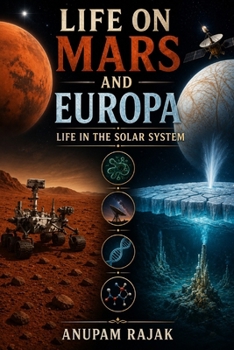
Life on Mars and Europa: Life in the Solar System

The search for life beyond Earth is one of the most fascinating scientific endeavors of the modern age. Combining biology, chemistry, geology, astronomy, and planetary science, the study of astrobiology seeks to answer some of humanity's oldest questions: How did life originate? Are we alone in the universe? Could life exist elsewhere in our Solar System? This book provides a comprehensive introduction to these questions by exploring the origin of life on Earth, the chemical foundations of living organisms, the characteristics of planets, and the exciting search for extraterrestrial life on Mars and Europa.
The book begins by examining the scientific theories and experimental evidence concerning the origin of life. Chapter 1 discusses the landmark Miller-Urey experiment, which demonstrated how organic molecules could be synthesized under conditions thought to resemble those of the early Earth. It also explores the Oparin-Haldane theory of chemical evolution, Francesco Redi's experiment that challenged spontaneous generation, the importance of fossil evidence in tracing the history of life, and the RNA World hypothesis, which proposes that RNA may have been the first self-replicating biological molecule. Together, these concepts provide a strong scientific foundation for understanding how life may have emerged from non-living matter.
Chapter 2 focuses on the chemistry of life by introducing the major biological macromolecules that form the structural and functional basis of all living organisms. The chapter explains the structure, properties, and biological significance of carbohydrates, proteins, lipids, and nucleic acids, highlighting their roles in metabolism, energy storage, genetic inheritance, cellular communication, and biochemical reactions. These molecules are also examined from an astrobiological perspective, illustrating why they are considered essential indicators in the search for life beyond Earth.
Chapter 3 provides an overview of the planets of our Solar System and their physical and chemical characteristics. Readers will learn about the composition, atmospheres, geological features, temperatures, and environmental conditions of the terrestrial and giant planets. The chapter discusses how these planetary environments influence the possibility of supporting life and introduces the concept of planetary habitability, helping readers understand why some worlds are more promising targets in the search for extraterrestrial organisms than others.
Chapter 4 is devoted to Mars, the most extensively explored planet in the search for ancient or present-day life. The chapter presents the history and achievements of numerous robotic missions, including orbiters, landers, and rovers that have investigated the Martian surface and atmosphere. It discusses the discoveries of ancient river channels, lake sediments, water-bearing minerals, organic compounds, methane observations, and evidence suggesting that Mars once possessed environmental conditions favourable for microbial life. The chapter also highlights current and future exploration missions that continue to expand our understanding of the Red Planet.
Chapter 5 explores Europa, one of Jupiter's largest moons and one of the most promising locations for extraterrestrial life within the Solar System. Beneath Europa's thick icy crust lies a vast global ocean that may contain more liquid water than all of Earth's oceans combined. This chapter examines Europa's geology, ice shell, subsurface ocean, hydrothermal activity, and the evidence supporting the possibility of habitable environments. It also discusses planned exploration missions and how future investigations may reveal whether microbial life exists beneath Europa's frozen surface.
Customer Reviews
ThriftBooks ® and the ThriftBooks ® logo are registered trademarks of Thrift Books Global, LLC
