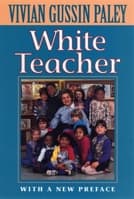
All these white schools I've been sent to are racist, Sonya says. I'd have done better in a black school. I was an outsider here. These are hard words for Vivian Paley, whose own kindergarten was one of Sonya's schools, the integrated classroom depicted by Paley in White Teacher. Confronted with the grown-up Sonya, now on her way to a black college, and with a chorus of voices questioning the fairness and effectiveness of integrated education, Paley sets out to discover the truth about the multicultural classroom from those who participate in it.
The book ask an interesting question, "Should African American students attend all African American Schools?" Throughout the book, teachers debate issue. Many psychologists supported the idea, but many of teachers in the book integrated their classrooms with vigor, which inspired some children to embrace diversity. For example, a Jewish student asked her parents if she could celebrate Christmas and they said yes. Yet, some schools lacked the understanding of diversity - one school's idea of a diverse classroom consisted of a special needs student in a class. The book sets in the 1990's evokes deep questions about race and its place in the American classroom, which are still being answered. Steven C. Thedford Author Kwanzaa Coloring Book www.kwanzaacoloringbook.com (404) 512-6760
0
★★★★☆
Communication is the key to the lock on multicultural edu.
By Thriftbooks.com User, April 26, 2000
I am an education major and read this book for an assignment. I am very impreesed with this book. I love the idea of using continuious stories to encourage students to think and question. I am especially fond of the relation that Ms. Paley and her colleague Lorraine share. If only conversations like theirs were held between Black and White teachers at every school!
0
★★★★☆
Missouri-MSC
By Thriftbooks.com User, April 25, 2000
Currently, I am a college student majoring in education. I chose this book for a class assignment and I enjoyed it. The author brought forth issues in regards to race, religion and just the mere diversity of the classroom. I feel this was easy reading addressing very strong issues, waying out the pros and cons of the multi-cultural classroom. I recommend this book to teachers, parents, students and anyone who share the concern for our educational system and the product of students that rise up and out into today's society.
0
★★★★☆
This book is an amazing catalyst for discussions.
By Thriftbooks.com User, September 23, 1999
I am a college student and read this book for an education class. To be honest I was less than impressed as I began reading it, but it held me rivited to find out what would come next. My feelings about the book as a whole changed at the conclusion when I realized the author wasn't trying to answer the questions of race and intergration, rather, she was giving us an opportunity to discuss it. Even in my group, which read and gave a presentation on the book, we found ourselves talking at length about racial and religious issues. I was impressed.
0
★★★★☆
thought provoking search into the black/white issue
By Thriftbooks.com User, September 20, 1999
The reviews on the back of the book gave me the impression that the book was more multicultural. It touched briefly on other ethnic groups or experiences, but it's main underlying themes appeared to be: should children (black or white) be taught by a teacher of their own race and is integration really at the best educational interest of young children? Ms. Paley posed these questions and answered them through interviews with parents, students, and other educators. I highly recommend this book for the thought provoking questions it raises. The answer seemed simple to me. I quote the book pg. 96: "Some people of any color simply have a better instinct for children." All we need is a little of Kwanzaa's empathy and a strong sense of community. This is what Ms. Paley seems to be telling us about the structure of our future schools if we (parents & teachers) truly wish to have integrated schools that meet the needs of our students at all their development levels.