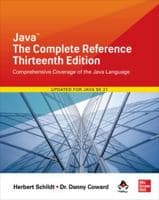
Java: The Complete Reference (Osborne Complete Reference Series)
Conditions
A read copy that remains in clean condition.
Formats
Conditions
A read copy that remains in clean condition.
Conditions
A read copy that remains in clean condition.
Formats
Conditions
A read copy that remains in clean condition.
Publisher's Note: Products purchased from Third Party sellers are not guaranteed by the publisher for quality, authenticity, or access to any online entitlements included with the product.
The Definitive Java Programming Guide Fully updated for Java SE 11, Java: The Complete Reference, Eleventh Edition explains how to develop, compile, debug, and run Java programs. Best-selling programming author Herb Schildt covers the entire Java language, including its syntax, keywords, and fundamental programming principles. You'll also find information on key portions of the Java API library, such as I/O, the Collections Framework, the stream library, and the concurrency utilities. Swing, JavaBeans, and servlets are examined and numerous examples demonstrate Java in action. Of course, the very important module system is discussed in detail. This Oracle Press resource also offers an introduction to JShell, Java's interactive programming tool. Best of all, the book is written in the clear, crisp, uncompromising style that has made Schildt the choice of millions worldwide. Coverage includes: -Data types, variables, arrays, and operatorsI love this book which is still relevant
As a C/C++ programmer switching to Java I found this book very helpful as a beginning book. It was pointed out that the author takes the time to go over why certain things are different between the two languages... It should be noted that if they were not pointed out would have landed me in quite a baffeling bit of trouble, as I am sure is the case with many others. It is agreed that the title is a bit much, but it is at the fault of Osborne not the author, it is the name of the series of books, and none of them are complete, but for that matter there is not a computer science book ever printed that completely covers a single subject... and I dare say there never will be either. With that said, a better title would be The Complete Beginners Reference, and for that purpose it is an excellent book, and that is why it got five stars... that was after all the books very obvious intention. Someone mentioned that using an API without knowing how it was built and absolutely works is bad practice... I have two comments on that actually, the first being is that if you bring that up at a meeting at work some day you will get alot of rolling eyes if you are lucky, but more than likely a good chewing out, or firing from the boss... you dont have time to understand ever facet of every single function, most of the time you are using bits and pieces of a program that multiple other people wrote and throwing it all into a program inside of a few months that would have taken you years to have wrote alone. Second, you have to learn to walk before you can run, and APIs are excellent ways to get into some more advanced stuff with out completely knowing what you are doing yet... humans do learn by trial and error after all, think about the first time one of your parents told you not to touch something hot. Lastly a leading authority does not mean he is the master of those languages... the people you mentioned are known as the best programmers of that language, there is alot more to programming than being extrememly good at manipulating the language... for instance you may have an extremely well founded knowledge of how the compiler handels your code... as does schilt... you may not be able to come up with the code, but you can look at it and tell exactly what it is going to do, we have several people at work that do that, they are horrable programmers, but they are extremely good at finding logic errors. Beginners need a good elementary base with this, and that is why they get someone who is good at it to write the book. So Kudos to Herbert Schildt on an excellent beginners book... and reference to those of us having a bad day.
This book as the name suggest gives you complete overview for learning and understanding Java. It clearly points out the differences between Java 1.4 and Java 1.5 (J2SE 5.0). It highlights the important points and gives introduction to Swings, Servlets and a good financial application using java. Good for any beginner !!
I have read many programming books. My opinion about them is that those book lack theory and concepts, those books are practical books. Practical teaching is a "mechanical" teaching and not a logicaly teaching. People with an IQ above the average needs theorically (logically) teaching, and those who are above the average are the best programmers. Practically methods are not for real world programmers, but for dummies. So, I think that : If someone gives to you a fish, he feeds you for a day, if someone teaches you how to catch fish he feeds you for all the life, and Schildt do this. Schildt use a high level language, which means that he uses the exact words and give the exact mean of what he wants to explain, others write a page to explain something and don't give the exact idea, of what Schildt uses only a paragraph to explain clearly that.
If you have a some background in Java then this book is a must. It has all the commands and functions listed out and what they do. I wouldn't recommend this book for beginners.
This book is well-written, and very good for beginner level and intermediate level in Java. And it has boosted my learning phase in Java !