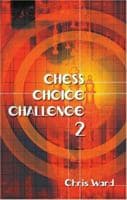
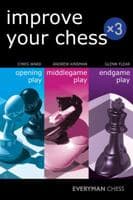
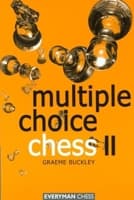
This book provides the reader with a selection of puzzles to solve. However, unlike other books of the White to play and mate in three' variety, it simulates real game scenarios, offering readers a choice of tempting alternatives and requiring them to pick the best.
Contains fundamental themes of opening, middlegame and endgame, in a "multiple choice" format which I find very educational: not only do you decide which is the good plan, but you should also find the reasons for rejecting the bad plans, thus gaining a better understanding of the position. It's a realistic simulation of real-life play, where you have to decide among several candidate moves. Probably most beneficial for players around ELO 1500, but, at 1700, I still missed a couple of positions in a hurry ;-) and greatly enjoyed the workout. For a tougher workout (or a second or third reading), solve the problems *without* reading the candidate plans. On a par with Silman's "Reassess your chess"/"The Amateur's mind" series, but less "theoretical" (no list of imbalances here), more compact (I carried it in my briefcase for a week) and with "multiple choice". Note that this (the "red book") is the easiest in Ward's three-volume "It's your move" series. The "blue book" is substantially harder and the "green book" is said to be even harder (haven't attempted it yet).
0
★★★★★
Very helpful chess book
By Thriftbooks.com User, September 24, 2005
This book is great for intermediate chess players. The problems range from openings, mid-game strategy, and end games. I found the problems challenging, and the fact you can choose from several different options with the wrong AND the right answer explained helped a lot (unlike the Silman books, which present one right answer without you knowing what was wrong with your own assessment). Be careful; this only refers to the red cover book (Improvers). The other editions are much different.
1
★★★★★
Excellent service
By Thriftbooks.com User, September 7, 2005
The book matched the description exactly, so I knew what I was getting.
0
★★★★★
An excellent book on planning
By Thriftbooks.com User, January 10, 2001
I'm writing this review mostly to give a counterpoint to the review below. Unfortunately, Mr. Thompson missed the point. This is not meant to be a book on tactics, but rather on finding a plan in the middlegame. The positions you'll see here are positions that might even appear in our own games, rather than only those of GM's. The idea is to chose, from among five choices, the best plan of action. These plans won't neccessarily win the game outright, but they'll lead to an advantage. In that respect, the book is excellent, and as far as I'm concerned, essential for a player who's got a good grasp of tactics and wants to take the next step. Along with Bronstein's Zurich International '53, this is one of the best books on middlegame planning I've seen; practice makes perfect.