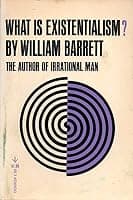
Widely recognized as the finest definition of existentialist philosophy ever written, this book introduced existentialism to America in 1958. Barrett speaks eloquently and directly to concerns of the 1990s- a period when the irrational and the absurd are no better integrated than before and when humankind is in even greater danger of destroying its existence without ever understanding the meaning of its existence. Irrational Man begins by discussing the roots of existentialism in the art and thinking of Augustine, Aquinas, Pascal, Baudelaire, Blake, Dostoevski, Tolstoy, Hemingway, Picasso, Joyce, and Beckett. The heart of the book explains the views of the foremost existentialists-Kierkegaard, Nietzsche, Heidegger, and Sartre. The result is a marvelously lucid definition of existentialism and a brilliant interpretation of its impact.
This book is quite helpful to all those interested in the study of existentialism. Whether you are a student of philosophy, psychology, literature, or love wisdom, this book will be very useful.Particularly useful are Barrett's summations of the four philosophers: Kierkegaard, Nietzsche, Heidegger, and Sartre.Finally if you're tired of those books on philosophy that truly transcend even the level of Einstein's comprehension, you will find this one to be very user friendly.
2
★★★★★
Existentialism may not work, but . . .
By Thriftbooks.com User, June 21, 2000
Near the beginning of his book, Barrett quotes a bit of verse by Yeats:"Now that my ladder's gone,/ I must lie down where all ladders start,/ In the foul rag-and-bone shop of the heart."This is the problematic of existentialism, which Barrett (correctly) identifies as the "homelessness" of man in a world bereft of religion, hitherto his only sure ladder to the transcendent. Existentialism might succinctly be defined as the attempt to continue living philosophically in the deafening, intolerable silence that follows the collapse of that ladder. This basic theme is traced from the thought of our forebears, as far back as Ecclesiastes and Augustine, but also more recently in Pascal and Swift, through Kierkegaard and Nietzsche, to Sartre, Camus, and Gabriel Marcel, among others. In the end Barrett seems to offer two conclusions. The first is that the choice between theism and atheism matters less than the recognition of man's desperation in the face of the Silence. The second is that unchecked rationality, enshrined in modern scientism (not to be confused with science) is the enemy of reason. There is, as he notes, a distinction between being rational and being reasonable; some of the most insane and ludicrous schemes--like Mutual Assured Destruction--have been arrived at with impeccable rationality, because no wisdom had interfered with the intelligence of those involved. Although existentialism cannot in the end offer a way out of the Silence, this book is invaluable for its humanizing theme and its recognition of facts that our culture is all too eager to sweep under the rug. It is worth the while of any thoughtful person to read it.