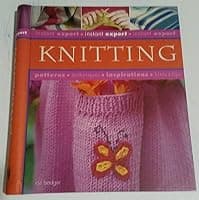
Knitting is therapeutic, satisfying, and fashionable. Create beautiful clothing, cherished gifts, and family heirlooms with the easy-to-follow instructions in Instant Expert: Knitting. The illustrated pages containing over 200 photographs teach readers how to read a pattern, determine gauge, and accurately shape each project. A helpful stitch library and discussion of color encourages increasingly confident knitters to design new looks. And the benefits—warm hand-knit pieces and an outlet to relax and refresh the mind—are irresistible. 30 projects include shawls and ponchos, floor cushions, baby blankets, mittens, and a dog coat. This book offers an informative and fun look at the history and development of knitting, This description may be from another edition of this product.
I don't think you can learn how to do the basics of knitting from this book or any other. I think you need to have someone show you casting on, knitting, purling, picking up stitches, and binding off. You have to try these basics a while too. That said, once you can do these things pretty well, this is a very good book for the next steps. Tools, gauge, types/weight of yarns, managing color, different stitch combinations, some easy projects, and then a start on designing. Also, for the price of this book, you can't go wrong even if you buy it for only one aspect.
1
★★★★★
This is just what I needed!
By Thriftbooks.com User, December 3, 2005
I really like this book! I am a novice knitter, and I needed something that did more than just show me a diagram. The bright, colorful photographs are beautiful, and the instruction is very clear! The book is filled with lots of different stitches, and several really neat patterns! If you were to purchase each of the patterns individually, the total would be MORE than the cost of this book! I've had experienced knitters tell me that they are going to buy this book because it is all inclusive!
1
★★★★☆
Instant Intermediate Knitter
By Thriftbooks.com User, May 19, 2005
As a knitting store employee and knitting teacher, I've been looking for an inexpensive starter's book that I could recommend to my students. This is it, sort of. The Good: I fully appreciate the historical section, especially the last 100 years. Excellent photography. I think that one could actually learn to knit by themselves with this book. Most books show you diagrams, which most people agree are useless, unless someone has already walked you through the stitches in person. Clear instrucions are included for most of the techniques, but many expert, even intermediate, techniques are missing. The Repairable: Three areas could use some clarification. I may have missed it, but it seems that the simple increase is the same as the fully finished increase. I prefer to increase by "making one," which is not explained. The other techniques missing are the "sling-shot" cast-on and some critical finishing techniques. It is written for a reader/learner. Those who learn with different styles may miss some very important points which are buried in text. On the other hand, a reader might read straight through and love it. The very best post-script would be: "A good starter book in a library of knitting literature."