


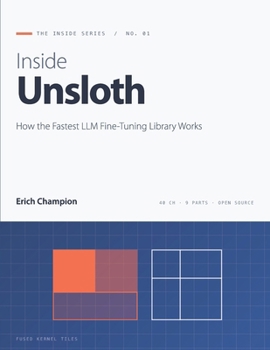
Inside Unsloth: How the Fastest LLM Fine-Tuning Library Works
No Customer Reviews

Inside Unsloth: How the Fastest LLM Fine-Tuning Library Works A Code-Level Walkthrough of Kernels, Model Patching, and Training Optimization --- You've used Unsloth to fine-tune models 2 faster. But do you know how it actually works? Inside Unsloth is the first book to crack open the Unsloth codebase and walk you through every layer - from import-time monkey patching to hand-written Triton kernels, from 4-bit quantized LoRA to fused cross-entropy loss, from model architecture dispatching to the Studio training interface. Unsloth is the open-source toolkit that lets you fine-tune Llama, Gemma, Qwen, Mistral, and dozens of other LLMs on a single consumer GPU. It achieves 2 faster training and 80% less memory through custom Triton kernels, fused operators, and aggressive memory optimization. This book traces every line of its Python source, showing you exactly how a 7B model trains on 6 GB of VRAM. What You'll Learn Triton Kernel Internals - How fused cross-entropy loss avoids materializing the full logit tensor, saving up to 1 GB per training step. How the RoPE rotation kernel processes four attention heads in a single program instance. How the SwiGLU backward pass reuses input buffers for zero-allocation gradients. Every kernel is annotated line by line. LoRA and QLoRA - The mathematical foundation (SVD decomposition, low-rank subspaces) and the engineering: how NF4 dequantization, matrix multiplication, and LoRA correction are fused into a single kernel launch, cutting memory traffic by 8.5 . The Patching System - How import unsloth reaches into transformers, TRL, and PEFT at import time to replace functions, fix bugs, and inject optimizations - all before your code runs. The complete catalog of 30+ patches that make existing training scripts run faster without any code changes. Reinforcement Learning - GRPO algorithm internals: group-normalized advantages, reward function composition, sandboxed code execution for automated evaluation. How Unsloth achieves 80% less VRAM for RL training by chunking rollouts and offloading the reference model. The Full Stack - Model registry and architecture dispatch. Device detection and multi-GPU placement. Sample packing and padding-free batching. GGUF export and Ollama integration. The Studio web interface for chat, training, and synthetic data generation. Who This Book Is For - ML engineers fine-tuning LLMs who want to understand the optimizations that make their training runs fast
- Triton/CUDA developers who want annotated, production-quality kernel examples
- Researchers building on Unsloth who need a deep understanding of the architecture
- Technical leaders evaluating fine-tuning infrastructure who want to understand the engineering behind the performance claims What Makes This Book Different This isn't a fine-tuning tutorial or a conceptual overview. Every chapter points to specific source files, traces concrete execution paths, and includes annotated code from the actual Triton kernels. ASCII diagrams show data flow through real functions. Tables map every concept to its primary source file so you can follow along in the code. The book covers 40 chapters across nine parts - from orientation and installation through model loading, training, saving, kernel internals, model architectures, Unsloth Studio, and advanced topics including import-time monkey patching, multi-GPU training, and the attention dispatch stack. 40 chapters - 9 parts
- Triton/CUDA developers who want annotated, production-quality kernel examples
- Researchers building on Unsloth who need a deep understanding of the architecture
- Technical leaders evaluating fine-tuning infrastructure who want to understand the engineering behind the performance claims What Makes This Book Different This isn't a fine-tuning tutorial or a conceptual overview. Every chapter points to specific source files, traces concrete execution paths, and includes annotated code from the actual Triton kernels. ASCII diagrams show data flow through real functions. Tables map every concept to its primary source file so you can follow along in the code. The book covers 40 chapters across nine parts - from orientation and installation through model loading, training, saving, kernel internals, model architectures, Unsloth Studio, and advanced topics including import-time monkey patching, multi-GPU training, and the attention dispatch stack. 40 chapters - 9 parts
Format:Paperback
Language:English
ISBN:B0HDKDJHHZ
ISBN13:9798191530635
Release Date:August 2026
Publisher:Independently published
Length:181 Pages
Weight:0.96 lbs.
Dimensions:11.0" x 0.4" x 8.5"
Customer Reviews
0 rating
Copyright © 2026 Thriftbooks.com
Terms of Use | Privacy Policy | Do Not Sell/Share My Personal Information | Cookie Policy | Cookie Preferences | Accessibility Statement
ThriftBooks ® and the ThriftBooks ® logo are registered trademarks of Thrift Books Global, LLC
ThriftBooks ® and the ThriftBooks ® logo are registered trademarks of Thrift Books Global, LLC
