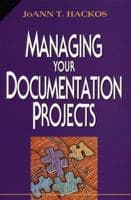
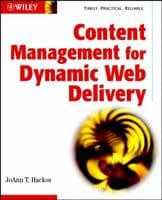
A revolutionary new resource that brings documentation product management ideas up to date The 1994 bestselling classic Managing Your Documentation Projects set the industry standard for technical documentation. However, since then, much has changed in the world of information development. With this new title, JoAnn Hackos looks beyond the structured project of the 1980s and 1990s. Instead, she focuses on the rapidly changing projects of the 21st century and addresses how to introduce agile information development without neglecting the central focus of planning information design and development around the needs of information users. As an information-development manager, you are expected to reduce costs and project time, do more work with fewer resources and less money, and increase the value of the information you deliver. Recognizing this, Hackos has carefully designed this book to help you do precisely that. She helps you make strategic decisions about information development and directs the discussion of project management toward smarter decision-making. An update of the original 1994 Information Process Maturity Model (IPMM) presents you with a method by which you can compare the state of your organization to others, evaluate your current status, and then consider what is necessary in order to move to the next level. Information Development offers a completely new look at best practices for all phases of the document development lifecycle, including: Managing a corporate information portfolio Evaluating process maturity Partnering with customers and developing user scenarios Developing team effectiveness and collaboration Planning and monitoring information projects Managing translation and production Evaluating project performance Managing for quality, efficiency, and cost-effectiveness The companion Web site includes electronic versions of the templates and checklists featured in the book. Wiley Technology Publishing Timely. Practical. Reliable. Visit our Web site at www.wiley.com/compbooks/
Any organization, large or small, that wants to get serious about growth should read this book, breathe it and master it. The first step is to admit you have a problem. "Hello, my name is Bob. I'm a wasteaholic."; "Hi Bob". I used to HATE process. HATE HATE HATE. I didn't want to be constrained; I rationalized saying "well it is a waste of time to invest time in process, it is just needless bureacracy". I was a creative person, still am. Then 10 years later I realized I was wasting a lot of time because things weren't organized, there wasn't accountability, the projects were driving me, instead of me being on top of things. Are you a wasteaholic? Answer this question: Do you feel on top of things? If answer = yes, close browser window. If answer = no, order book. Book is dead on. Several years ago I interviewed for a staff position at Cornell University, in a dept. run by a guy who had spent a number of years in industry; I wanted to impress him, so I asked, "are there any books you'd recommend, out of all you've come across, about project management and content?" And he said "Managing Documentation Projects" -- which is the precursor to this book. It rocks.
0
★★★★★
A truly recommendable read
By Thriftbooks.com User, June 15, 2007
In this book, JoAnn T. Hackos has compiled a great amount of useful information, "decorated" with many illustrating sample cases. Well-structured, intelligible and applicable, "Information Development" is a welcome asset, although with 600 pages, it is nothing you read - least of all SHOULD read - overnight. :)
0
★★★★★
New book -- not 2nd edition
By Thriftbooks.com User, June 3, 2007
Please note that none of the reviews below are written about the 2006 new book on Information Development. The book is not a 2nd edition; it's an entirely new book with new content. The focus is on strategically managing a publications organization and effectively managing projects. The project management part of the book focuses on agile methods and managing topic-based writing activities.