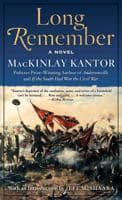
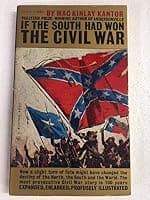
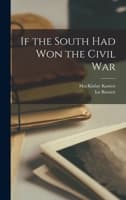
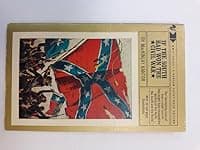
MacKinlay Kantor, Pulitzer Prize-winning author, master storyteller, shows us how the South could have won the Civil War, how two small shifts in history (as we know it) in the summer of 1863 could have turned the tide for the Confederacy. What would have happened: to the Union, to Abraham Lincoln, to the people of the North and South, to the world?
If the South Had Won the Civil War originally appeared in Look Magazine nearly half a century ago. It immediately inspired a deluge of letters and telegrams from astonished readers and became an American classic overnight. Published in book form soon after, Kantor's masterpiece has been unavailable for a decade. Now, this much requested classic is once again available for a new generation of listeners.
It all begins on that fateful afternoon of Tuesday, May 12, 1863, when a deplorable equestrian accident claims the life of General Ulysses S. Grant ...
I'm definitely checking out the rest of Kantor's other books. I found a few new names of history to look up. I only wish the ending gave a more cut-clean conclusion, but that's fiction for you; still five stars out of five stars though!
1
★★★★★
If the South had won the 'Civil War' - what a delightful thought!
By Thriftbooks.com User, May 11, 2008
I love this little book of 'alternative' or 'what if?' history - only 127 pages in the edition I have - and, though reading it occupies a mere hour or so, it deals with the delightful thought that 'The War for Southern Independence' might have ended much earlier, in 1863, and very differently, if a couple of relatively minor happenings had had different outcomes, and it acts as a tonic to those of us who still believe in the Southern cause. The reason I write this is because MacKinlay Kantor does not describe a victory for the old Confederacy as a triumph for illiberal white supremacists, more a rational and sensible reinstitution of peace and civilisation for both North and South. For example, one of Mr Kantor's imagined heroes is 'Rel' Stuart - Robert Edward Lee Stuart, son of General 'Jeb' Stuart - a Congressman from Virginia who becomes Governor of the C.S. State of Cuba. (That would be infinitely preferable to the Castro brothers, surely?). I won't reveal the whole of the logically and carefully crafted tale: suffice to say that the people prosper, that slavery dies a death in the late 1800s (the 'Liberation Act' being passed by the Confederate Congress in 1885, with provision for financial restitution for slave-owners), and that the old 'United States' are likely to be reunited following a conference between the Presidents respectively of the Confederate States of America, the United States of America and the Republic of Texas, at Washington, D.D. (District of Dixie) - in April, 1961, one hundred years after the firing on Fort Sumter. Relatively light reading regarding a very heavy subject - but so enjoyable!
3
★★★★★
Doesn't Waste Words
By Thriftbooks.com User, September 2, 2005
Mr. Kantor's 100-page alternate reality reads like an overview from a history lesson. He tells an intelligent story of how the southern states might have come out victors in 1863, gaining independence and avoiding what would have been the final, bloodiest two years of the American Civil War. Kantor tell of how the losses of Sherman and Grant, along with other developments (that in some cases very nearly happened) changed history and ended the war in favor of the south. He goes on to trace the history of the American nations over the next century, from the Davis, Lee, Jackson and Stuart administrations in Confederate-controlled Washington DC, thru the building of the new US capital, Columbia, in present-day Columbus, Ohio. Kantor tells of Texas' withdrawal from the Confederacy and its annexation of the Indian territory to its north. He introduces us to popular figures, like multi-term Virginia Senator Robert E. Lee Stuart, son of JEB, an extraordinary man who never existed in our own timeline. Kantor creates a believable example of the way it could have been and does a handy job of making all this interesting. Read this (in about as long as it'd take you to watch a movie of the week on TV) and you'll feel enlightened by this window into the way things nearly were.
2
★★★★★
And this is what could have happened...
By Thriftbooks.com User, November 27, 2003
I can't believe that it's nearly 50 years since I read Kantor's Pulitzer Prize-winning novel "Andersonville"Somehow I missed this 'what if'when it came out in LOOK magazine and book form as well as all the hoopla it created.It is a short, but enjoyable speculation.How realistic the results could be is anybody's guess.I guess it is all in where one is coming from ,but the important thing is that Kantor's version is plausible and makes for good reading.It is an art, and not a science ,to look back in history to determine what and why things happened;and when one attempts to look to the future there are no constraints at all;so,anything is fair game. Trying to speculate what would have happened if Kennedy was not killed in Dallas...heck,we're not even sure why, or even if, he was shot by Oswald. The introduction by Harry Turtledove is excellent and has some very good points to make on alternate history writings.Kantor has whet my appetite for more.I am about to start on "What If", edited by Robert Cowley.I think one of the comments made about it by Milwaukee Journal Sentinel, "...history is not an inevitable march of dusty names,dates and places,but a precarious,careening ride that could have taken us to any number of destinations." I guess that about says it all.