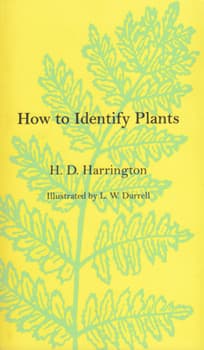
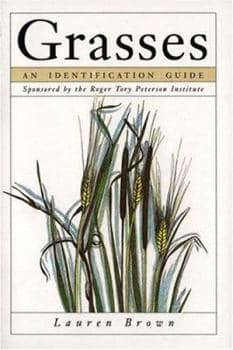
There is no easy was to identify grasses. And no one understood this better than H.D. Harrington, who observed thousands of students struggle and learn. His clear, concise, and well-organized guide will continue to be a basic and essential text for use in the classroom or in the field. The book contains over 500 drawings and an illustrated glossary.
There are a lot of plants that become colorful on the earth. The plant that occupies the majority of Holocene place is a grasses and grasslike plants. However, if it is not a specialist, the grasses and grasslike plant are not distinguished easily. I am a farmer. The grasses and grasslikes were an annoying weed in me. This book is a book that gave me new feeling to the grasses and grasslikes. It is not an interpretation weed in me any further any longer. I give my thanks to Doctor Harrington. This book is as splendid as "Peterson first guides". I call this book and "How to identify plants" "HARRINGTON MANUALS" !
0
★★★★★
A lot of information in nearly pocket size book
By Thriftbooks.com User, March 2, 2007
I finally bought a copy of this book for myself after having to borrow it from my plant friends and professors. They would not permit it out of their sight! Anyway it is a very good start to getting accustomed to grasses. They can be quite challenging to identify but this book is very helpful. It is pretty basic, to the point and recommended. It may be a bit challenging for a newbie, but really there is no easy way to learn plant terminology. This one is a good ice breaker!
0
★★★★★
How to Identify Grasses & Grasslike Plants
By Thriftbooks.com User, April 10, 2003
This book is practical and systematic. The topic is difficult, at best, and the author gives all the tools and understanding needed to build up your skills. As a consultant that works with native plant materials, I have found this book to be a useful field reference in separating out invasive species.
0
★★★★☆
Excellent manual on morphology of these difficult groups.
By Thriftbooks.com User, May 22, 1999
As a former student of the late Dr. Harrington who taught me much about plant classification, I highly recommend this book. It is similar to his How to Identify Plants, but the diagrams are much better. It is a very thorough review of the morphology and terminology specific to sedges, rushes, and grasses. These are all very difficult families to identify and there are few books that so thoroughly describe the critical and unique morphology of these plants. This is a knowledge that is critical to the identification of these fascinating and important plants. Dr. Harrington also includes a section on the vegetative characteristics, especially of grasses. For field ecologists like myself, being able to identify plants without the flowers, especially grasses, is critical when doing quantitative sampling. If you are just a beginner in your pursuit of these difficult plants, this is an excellent and valuable resource. But for even the plant scientist this book provides an excellent reference to refresh your memory regarding the unique and important mophology of grasses, sedges, and rushes.