
Skip to content
Scan a barcode
Scan
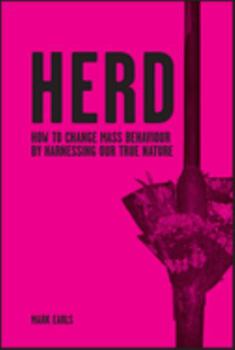
Hardcover Herd: How to Change Mass Behaviour by Harnessing Our True Nature Book

ISBN: 0470060360

ISBN13: 9780470060360

Herd: How to Change Mass Behaviour by Harnessing Our True Nature

Select Format

Select Condition ThriftBooks Help Icon

Recommended

Format: Hardcover

Condition: Very Good

$10.59
Save $29.36!
List Price $39.95
Almost Gone, Only 2 Left!
Save to List

Book Overview

Can you explain the explosion of social activities like text messaging with little or no promotion of the behaviour? How a Mexican wave happens? The emergence of online communities? Or - more sensitively - the steady rise of floral roadside tributes to traffic accident victims from complete strangers? Unless you have a good explanation of mass behaviour, you'll have little chance of altering it.

Herd reveals that most of us in the West have completely misunderstood the mechanics of mass behaviour because we have misplaced notions of what it means to be a human being. With a host of examples from Peter Kay and urinal etiquette to Apple and Desmond Tutu, Mark Earls offers the most new radical, controversial and significant new theory of consumer behaviour in a generation.

"At one level a profoundly simple and important idea, that just happens to overturn everything we thought we knew about marketing to the individual."
--Adam Morgan, Founder, Eatbigfish

"Mark Earls helps us see clearly that we need to re-write the rules and provides us with a playbook for doing so. Are you ready for the 'we' revolution?"
--Ed Keller, CEO, The Keller Fay Group

"Herd is a dazzling, nutrient-rich read that urged me to see afresh the big underlying forces driving media behaviour and why they especially matter now."
--David Abraham, EVP, The Learning Channel

"As important to read as Malcolm Gladwell and Adam Morgan were. I cannot recommend it highly enough unless you are a luddite or an ostrich."
--Mark Sherrington, Global Brands Director, SABMiller

"Read this book. Think about it. If you're going to be any good at your job in the next 20 years then you need to questions your assumptions about how stuff works."
--Russell Davies, Founder, Open Intelligence Agency

Customer Reviews

4 ratings

Thank goodness someone gets it!

"Herd" is a significant book for anyone in the marketing profession. Although I am glad that I did not read it when it first came out, instead having gotten caught up in other human behavior concepts like "Buyology" and other how the brain works reading, it was the book that validate my new thinking...we are not as unique as we are being told we are!. I remember being enthralled by the idea that we could/should dissect human behavior down to a 1:1 level. Along with anyone who has worked in the CRM world, you have come to realize that the execution on such a level is impossible, if for no other reason then the fact that your corporate infrastructure is not set up to care about people that much. Herd provides an excellent orientation to getting marketing folks back to capturing the true essence of human behavior and providing a better foundation from which to build effective customer services. A foundation that is more readily executable, therefore making relationships more attainable.

Refreshing

I really enjoyed this book. Mark Earls combines a light, at times playful style of writing with good ideas and a refreshingly well researched investigation. In this way, Herd is as Russell Davies suggests, a pleasant change from the many marketing books that are little more than "very long business cards". Earls investigates market behavior from the position that we humans are first and foremost social beings. He does this by drawing on a wide range of well referenced resources stemming from ethology, biology, anthropology, marketing studies and so on. On the background of this data Earls suggests that if marketers want to be truly effective they will need to start thinking about how people naturally influence one another. This rather than how marketers have tended to think that they are able to exert influence over those they narrowly think of as consumers. He proposes that this implies a shift from direct relationship marketing (where the lines of communication exist between company and customer) to citizen to citizen marketing (where the company creates opportunities for people to interact with one another). You need only consider the popularity of social media like myspace and facebook to realize why this approach makes sense. In addition, Earls' work provides a good counter position to the current buzz around neuromarketing, which claims to be able to understand more about consumer behavior by examining individual brains. As Earls suggests, while this is all good and well - it may miss the point by neglecting to consider the influence of others on our behavior. Thoroughly enjoyable!

A rare 'business' book - it actually makes you think

I've just finished reading Herd. Actually, I devoured it in two sittings. And I urge you to go and read it if you want to think about how to better trigger changes in mass behaviour. Unlike most business or marketing books it's not a set of case studies or a 'how to' process guide to mechanistic thinking. Rather, it's an excellently written analysis of the new thinking (and the forgotten old thinking) about how people think, act and behave. It doesn't give you answers or tell you what to do, but rather raises questions in your mind about the principles on which most communications thinking is built. Already, it's made me question a lot of the assumptions I have been taking for granted, made me think differently about some of the problems I'm trying to solve and helped me ground some of the different thinking I've been doing over the last couple of years. Whether you agree with all the conclusions or not, we need more stuff like this that brings fresh, challenging, provocative thinking into the far too conservative world of marketing and communications.

How movements really happen.

Recently, books like The Tipping Point by Malcolm Gladwell or the Influentials by Jon Berry and Ed Keller, have captured the imagination of marketers and the public alike. It's easy to see why. They propose a tidy and believable model of influence. 1.) There are some people who are more influential. 2.) If we can just reach them, we can influence large numbers of people. Accepted as gospel, these two ideas have spawned entirely new industries and companies devoted towards creating "viral marketing." Happily for all of us, things just don't work that way. Brand spanking new research from P & G and Duncan Watts is serving as confirmation of Mark's thesis: it is our innate nature as "herd" animals that causes mass movements, not the influence of a handful of individuals. This simple little insight overturns much of what we currently think about and how we approach marketing. If you're serious about creating real movements in the new marketing landscape you simply have to read this book.
Copyright © 2026 Thriftbooks.com Terms of Use | Privacy Policy | Do Not Sell/Share My Personal Information | Cookie Policy | Cookie Preferences | Accessibility Statement
ThriftBooks ® and the ThriftBooks ® logo are registered trademarks of Thrift Books Global, LLC

GoDaddy Verified and Secured