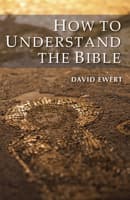
What does the word "Bible" mean? Who wrote the Bible? Has it changed over time? Why are there so many translations?
A General Introduction to the Bible answers these questions and more. Without becoming too technical for the average layperson, David Ewert surveys the history, formation, transmission, and translation of the Christian Bible in an informative and captivating way.
Topics include:
Meaning of "Bible" and the naming of biblical books
Transmission of sacred scriptures
The thousand-year story of the English Bible
Bible organization
Development of biblical languages
Canon of the testaments
Extracanonical books
Early versions of the Bible
Choosing a translation
Features include:
Photographs of ancient texts, Bible pages, key individuals, and settings
Maps and charts that show the development of languages, textual families, and the relationship of various translations and revisions
Suggested readings and an extensive glossary and index
From ancient tablets to modern translations--God's Word to humanity has been profoundly impacting the world for several millennia. And after learning about its fascinating history, your appreciation for the Bible will surely increase even more.
Comments Emphasising Respective Merits & Textual Integrity of the 2 Primary Catholic (Douay-Rheims
By Thriftbooks.com User, January 2, 2009
David Ewert's account of many aspects of the Bible's transmission down through the centuries is very interesting and much of it quite pertinent even to the average informed Christian layman. There seem to be far too many common misunderstandings about both the historic Douay-Rheims, Douay-Rheims-Challoner, and Authorised "King James" version Bibles among Christian laity and even among the clergy and scholars in the Protestant and Catholic ranks. Nevertheless, it remains true today as it has in the past that the two strongest and most faithful Bible versions in English are the Authorised "King James" Version (translated from the Masoretic Hebrew text of the Old Testament, various Greek and Latin texts of the books of the Apocrypha, and Byzantine "Textus Receptus" Greek of the New Testament), the ultimate Scriptural authority in English for Anglicans and Protestants, and the Douay-Rheims-Challoner Version (translated throughout from the Clementine Latin Vulgate Bible). The comments here deal with these two great English translations ("versions") of the Bible into English. The Douay-Rheims-Challoner Version never attained the kind of near conformity in wording of editions across the years of the Authorised "King James" Version (A.V.). The A.V. Bible did benefit from its "Crown Copyright" protection from having to endure the ravages that unauthorised and bold revisions, or other changes to wording, inflicted upon other versions. The small variants which do exist in the texts of the A.V. as the university presses of Cambridge and Oxford in England (and in Scotland of the few publishers there licensed by the Crown to publish the A.V. there) are so superficial as to require rather a lot of effort to detect. They derive from various officially-sanctioned revisions, to matters only of minute detail, to the A.V. that the two leading British universities undertook, with Royal approval, in the 17th and 18th centuries. These licensed university publishers in the United Kingdom often printed the A.V. for the Bible societies, as well, in Scotland, such privileged publishers with important lines of Bible in their catalogues as Eyre & Spottiswoode and Collins. These university and private British publishers often printed the A.V. for the Bible societies in the U.K. and even abroad. The most grievous variance is the increasingly frequent omission over the years of the A.V.'s Apocrypha (and, yes, the deutero-canonical books are an authentic part of the A.V.!), due to unrelenting pressures from the "dissenters" (or "non-conformists") of Britain's various non-Anglican Protestant denominations and sects, and especially due to early opposition to the inclusion of the Apocrypha in Bibles printed or distributed by the British and Foreign Bible Society and the Trinitarian Bible Society in Britain (representing many non-Anglican Protestant groups as well as the more Apocrypha-friendly Church of England) and by some Bible societies elsewhere. This policy of the vari
1
★★★★★
Review
By Thriftbooks.com User, July 25, 2008
The book was in great condition just as it was stated. I received it much quicker than expected. Thanks
1
★★★★★
Wealth of information, interesting read
By Thriftbooks.com User, March 10, 2004
This book is a great source of background info on the written Bible. Most interesting to me is the history of Bible translation (languages, scholars, manuscripts, influences). The author covers the history of writing/printing, formation of the Bible canon, theories of translation, and issues related to the scribes. Also included is commentary on the modern English translations. The author goes into enough depth to provide a basis of understanding and good reference, but the style allows it to be read straight through. Surprisingly, I found this book to be a page-turner!