


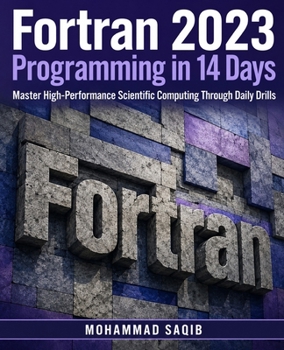
Fortran 2023 Programming in 14 Days: Master High-Performance Scientific Computing Through Daily Drills
No Customer Reviews

Fourteen days. One compiler. Every program in the book compiled with -std=f2023 before it was printed.
Fortran looks like a language everyone half-knows, and that is what makes it dangerous: a kind is a number rather than a promise of precision, a character variable has a length fixed at declaration, and a misspelled name without implicit none becomes a new variable instead of an error. Each of those is a rule with an exact answer, and the book drills the answer. On Day 1 the rule is implicit none, and flux prints only its own name and version. By Day 7 flux is organised into modules with an interface separated from its body. By Day 10 it reads a real grid from a file and checks iostat on every read rather than trusting it silently. By Day 14 flux finishes with a parallel reduction proved with do concurrent, coarrays and OpenMP, all compiled with the compiler of record. Every example in this book was compiled with GNU Fortran 15.2.0 under -std=f2023 before it was printed. 458 figures across 14 chapters carry what a listing alone cannot. 340 output blocks are pasted from a captured compile and run, never typed from memory. 396 pages hold 46 to 56 numbered problems per chapter, drilled rather than assumed. Fourteen chapters, one vehicle, one compiler, one standard, named on every page that needs it. YOUR 14-DAY PATH Day 1 - The Program and the Compiler: flux v0 prints its own name and version.Day 2 - Types, Kinds and Precision: flux gets a typed value reader.
Day 3 - Arrays and Whole-Array Expressions: flux gets its grid type and a shape report.
Day 4 - Array Sections, Reshape and Reductions: flux gets its row and column statistics.
Day 5 - Control Flow and Do Concurrent: flux gets its smoothing stencil loop.
Day 6 - Procedures, Arguments and Intent: flux is split into procedures with explicit interfaces.
Day 7 - Modules and Submodules: flux gets its module layout.
Day 8 - Derived Types and Type-Bound Procedures: the grid becomes a derived type with its own operations.
Day 9 - Allocatables, Pointers and Memory: flux gets dynamic grid allocation.
Day 10 - File Input and Output: flux gets its grid file reader, with iostat checked on every read.
Day 11 - Character Strings and Formatting: flux gets its formatted report.
Day 12 - IEEE Arithmetic and Numerical Error: flux gets a tolerance-aware comparison instead of equality.
Day 13 - Performance, Memory Order and Timing: flux gets a timing report, measured with system_clock.
Day 14 - Parallelism, Do Concurrent, Coarrays and OpenMP: flux finishes with a parallel reduction and its final report. WHO IT IS FOR. A programmer who already writes code in some language and wants modern Fortran -- arrays, modules, derived types, and parallelism -- taught as it is written today, not as it was written in 1977. You need GNU Fortran 15.2.0 or a close compiler, and a command line; no IDE is assumed. You do not need any external numerical library: flux is standard Fortran throughout, and the three F2023 features this compiler does not yet implement are named rather than pretended away. Download book source code from: {GitHub}/{mohammadnsaqib} 396 pages, in colour.
Format:Paperback
Language:English
ISBN:B0HGBKGR91
ISBN13:9798194533374
Release Date:August 2026
Publisher:Independently Published
Length:400 Pages
Weight:1.51 lbs.
Dimensions:0.8" x 7.5" x 9.3"
Customer Reviews
0 rating
Copyright © 2026 Thriftbooks.com
Terms of Use | Privacy Policy | Do Not Sell/Share My Personal Information | Cookie Notice | Cookie Preferences | Accessibility Statement
ThriftBooks ® and the ThriftBooks ® logo are registered trademarks of Thrift Books Global, LLC
ThriftBooks ® and the ThriftBooks ® logo are registered trademarks of Thrift Books Global, LLC
