


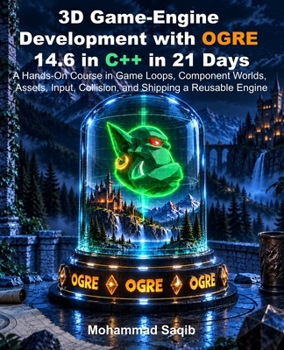
3D Game-Engine Development with OGRE 14.6 in C++ in 21 Days: A Hands-On Course in Game Loops, Component Worlds, Assets, Input, Collision, and Shipping
No Customer Reviews

Twenty-one days, one 3D world, and a folder that runs on somebody else's machine. OGRE 14.6 renders scene graph, meshes, materials, lights, cameras -- nothing else: no game
loop, object model, input, collision, audio, events, save files, or way to
ship. This book writes every one, in C++: the Lantern Keep. Gameplay code never calls Ogre:: itself. On Day 1 you render one frame
to a file, no window opening; by Day 12 a data file assembles the keep; on
Day 21 the project is a folder a stranger can unzip and run with no OGRE SDK. Everything printed here was run: 407 figures in colour, 197 of them
screenshots, 153 listings, 107 questions,
75 exercises. It prints the inconvenient
results too -- 181,040 collision tests becoming 86,228, 3,441,600 square roots becoming none, same every run (Day 20). YOUR 21-DAY PATH Day 1 - What OGRE Hands You, and What It Does Not: a Root, a CMake project, and a frame written to a PNG.
Day 2 - The Renderer in a Day: Scene Graph, Meshes, Materials: a mesh is not an entity, an entity is not a node.
Day 3 - Cameras, Lights, and What One Frame Costs: three light types, attenuation, one frame's cost.
Day 4 - The Boundary: Why Gameplay Must Never See Ogre::: a header with no OGRE in it, the welded counter-case.
Day 5 - The Engine Object, and the Order Things Start In: start-up order is the dependency graph, written down.
Day 6 - The Loop: Fixed Timestep, and the Render That Follows: two clocks, an accumulator, the spiral of death.
Day 7 - Time, the Frame Budget, and the First Instrument: a profiler drawn into the frame, sorted by cost.
Day 8 - Game Objects Are Not Entities: composition over inheritance, one vector of slots.
Day 9 - Handles, Lifetime, and Destroying Things Safely: an index plus a generation, one comparison.
Day 10 - The Bridge: One Place Where the Two Worlds Touch: attach once, a dirty flag, a picture that lies.
Day 11 - Assets: Groups, Manifests, and Loading Without Stalling: a manifest, a budget checked before each load.
Day 12 - Prefabs, and the Lantern Keep Assembling Itself: a dull text format, and a spawn storm lifted clear.
Day 13 - Input: Devices, Actions, and Rebinding: one layer over devices, a context stack, three bugs.
Day 14 - Collision, and a Warden Who Cannot Walk Through Walls: discrete moves tunnel, swept moves do not.
Day 15 - Events: Decoupling Systems That Must Not Know Each Other: publish queues, deliver drains, one tick later.
Day 16 - Audio: Sound That Has a Position: equal-power panning, and a real WAV written to disk.
Day 17 - Data-Driven Behaviour: Changing the Game Without Rebuilding: rules from a file, and a bad file that is a no-op.
Day 18 - Save Files, and Bytes That Have to Outlive the Program: text, a version token, a differ as the test.
Day 19 - Tools: A Console, an Inspector, and 14.6's Gizmos: a console that writes to the world, and gizmos.
Day 20 - Counting the Work Before You Trust the Clock: a count outlives a clock; one cut added work.
Day 21 - Cooking and Shipping: A Folder Somebody Else Can Run: an explicit cooked list, a folder that runs. WHO IT IS FOR. A C++ programmer who wants to understand a renderer, not drive an editor.
You need enough C++ to read a class definition, and OGRE 14.6 -- no rasteriser to write.
Every day names what it leaves undone and which day does it; three appendices
print the finished program, every OGRE type, and a glossary. Download book source code from: {GitHub}/{mohammadnsaqib} 498 pages, in colour.
Format:Paperback
Language:English
ISBN:B0HMQQYK71
ISBN13:9798175733076
Release Date:October 2026
Publisher:Independently Published
Length:500 Pages
Weight:1.87 lbs.
Dimensions:1.0" x 7.5" x 9.3"
Customer Reviews
0 rating
Copyright © 2026 Thriftbooks.com
Terms of Use | Privacy Policy | Do Not Sell/Share My Personal Information | Cookie Notice | Cookie Preferences | Accessibility Statement
ThriftBooks ® and the ThriftBooks ® logo are registered trademarks of Thrift Books Global, LLC
ThriftBooks ® and the ThriftBooks ® logo are registered trademarks of Thrift Books Global, LLC
