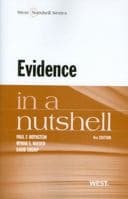
Federal rules of evidence are the anchor of this single-volume Nutshell. The text summarizes significant U.S. Supreme Court decisions, additional leading cases, and principal schools of evidentiary thought. Expert coverage includes practical implementation of the rules at trial or their connection to pre-trial or post-trial proceedings. Areas of interdisciplinary cross-pollination are noted as well. This description may be from another edition of this product.
The first principle of evidence involves relevancy. Evidence isrelevant if a reasonable fact-finder could feel that it renderssome fact more probable or less probable in any degree than itappeared before the introduction of the evidence. Relevancy does not require that the fact be made to appear highly probable.We are not testing sufficiency of the total proof of a case.Instead, the basic rule seeks to establish an entry thresholdupon which a building block may be constructed. In some cases,the judge and jury may have to resort to matters not in the record to determine whether or not a piece of evidence rendersa proposition more probable than before. As a basic principle,relevancy subsumes materiality. The remainder of the book explains presumptions under the law, heresay, impeachment ofwitnesses, exemptions and a whole host of complicating factorsrelevant in a trial setting.The book is written for a legal constituency. It assumes somelegal background or knowledge of basic definitions. The constituency of this book consists of legal scholars, lawyers,law students and a wide constituency in business and academe.It is well worth the price for serious students of the law.