


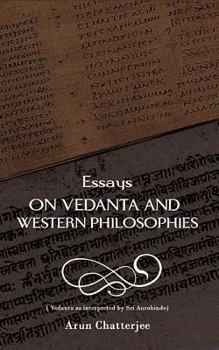
Essays on Vedanta and Western Philosophies
No Customer Reviews

Philosophical issues such as reality and appearance, God and world, self and not-self, rebirth and immortality, free will and determination, mysticism, etc., have been examined by eastern and western philosophers as far back as the sages of Upanishads (700 BCE) in the East, and Plato (400 BCE) in the West. However, there was no significant communication among the philosophers of the East and West perhaps until the eighteenth century. Arthur Schopenhauer (1788-1860) was one of the first among the great western philosophers to recognize the value of Indian philosophies. Despite the lack of communication there are striking similarities of concepts and issues addressed by Indian and western philosophies. Also interesting is how similar are the mystical versions of different religions of the East and West. The author, Dr. Arun Chatterjee, has attempted to bring out the similarities and differences in various chapters of this book dealing with different topics. Among Indian philosophies the focus is on Vedanta philosophy and the views of Sri Aurobindo (1872-1950). The views of Swami Vivekananda (1863-1902) also are presented. Other Indian philosophies such as Sankhya and Buddhism are discussed briefly. Among western religions Judaism, Christianity, and Islam are discussed.
Format:Paperback
Language:English
ISBN:0940676362
ISBN13:9780940676367
Release Date:July 2018
Publisher:Lotus Press (WI)
Length:176 Pages
Weight:0.60 lbs.
Dimensions:0.5" x 5.4" x 8.7"
Customer Reviews
0 rating
Copyright © 2026 Thriftbooks.com
Terms of Use | Privacy Policy | Do Not Sell/Share My Personal Information | Cookie Policy | Cookie Preferences | Accessibility Statement
ThriftBooks ® and the ThriftBooks ® logo are registered trademarks of Thrift Books Global, LLC
ThriftBooks ® and the ThriftBooks ® logo are registered trademarks of Thrift Books Global, LLC
