


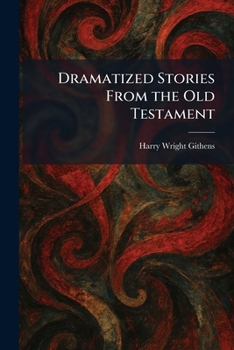
Dramatized Stories From the Old Testament

Select Format
Select Condition 
Book Overview
"Dramatized Stories From the Old Testament" is a collection of creative dramatic adaptations designed to bring the foundational narratives of the Hebrew Bible to life for contemporary audiences. Written by Harry W. Githens, this work transforms familiar scriptural accounts into engaging performances, making the ancient texts accessible and vivid through dialogue and action. The collection includes a wide variety of stories, ranging from the trials of the patriarchs to the leadership of prophets and the epic struggles of the Israelites.
Each dramatization is crafted with a focus on educational and spiritual impact, making it an ideal resource for religious educators, youth groups, and community theater organizations. By translating biblical prose into theatrical form, Githens emphasizes the human elements of these sacred stories, allowing participants and viewers alike to connect more deeply with the moral and historical themes of the Old Testament. Whether used for liturgical presentations or classroom enrichment, these plays offer a practical and imaginative way to explore the timeless lessons and character studies found within the scriptures. This volume serves as a significant example of religious pedagogy and the use of theater as a tool for faith-based learning.
This work has been selected by scholars as being culturally important, and is part of the knowledge base of civilization as we know it. This work was reproduced from the original artifact, and remains as true to the original work as possible. Therefore, you may see the original copyright references, library stamps (as most of these works have been housed in our most important libraries around the world), and other notations in the work.
This work is in the public domain in the United States of America, and possibly other nations. Within the United States, you may freely copy and distribute this work, as no entity (individual or corporate) has a copyright on the body of the work.
As a reproduction of a historical artifact, this work may contain missing or blurred pages, poor pictures, errant marks, etc. Scholars believe, and we concur, that this work is important enough to be preserved, reproduced, and made generally available to the public. We appreciate your support of the preservation process, and thank you for being an important part of keeping this knowledge alive and relevant.
Customer Reviews
ThriftBooks ® and the ThriftBooks ® logo are registered trademarks of Thrift Books Global, LLC
