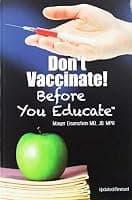
Don't Vaccinate Before You Educate
Conditions
A read copy, but remains in excellent condition.
Formats
Conditions
A read copy, but remains in excellent condition.
Conditions
A read copy, but remains in excellent condition.
Formats
Conditions
A read copy, but remains in excellent condition.
This book is not meant to convince you to vaccinate or not vaccinate your children but to open your eyes to the ongoing debate.
To educate means to widen one's horizons. I hope that this book will be educational with regard to the vaccine issues and inspire you to become more educated with regard to the risk vs. benefits of vaccine programs.
I have included just a few of the many pro and con scientific vaccine studies. Many more can be obtained by going on the internet to the multiple vaccine sites as well as to the on-line versions of some of the most prestigious medical journals (BMJ, AMA, Pediatrics, Lancet, Journal of Disease of Children). This description may be from another edition of this product.
A few years ago I had a very difficult time trying to find any research speaking out against Vaccines for a term paper in nursing school. The problem was that my school didn't carry the publications speaking out against them, and EBSCO Host (the online directory they allowed us to use) also failed at this miserably. I ended up with an overwhelming amount of pro vaccine literature. I ended up giving a gentle nod of approval to the pro vaccine camp at that time, but I was always bothered by one thing: why were so many of the experts writing these articles collecting money from the vaccine and pharmaceutical companies? This peeked my interest, and I knew I would have to do more research in the future to give both sides of the argument equal access. The author Mayer Eisenstein MD, JD, MPH has established a medical practice with other physicians in the Illinois area. He has between 20,000 to 30,000 thousand (going off of memory on that number) patients from birth and not one of them has autism. Some of his patients that went to other clinics and received vaccinations prior to coming to him have autism, but that's beside the point. Dr. Eisentein tells the reader his bias up front and then gives arguments for and against vaccines in the book. He gives articles from established journals both for and against vaccines. He gives both sides of the argument a voice, and to truly make an INFORMED decision you have to have that... Dr. Eisenstein makes some very good points that most parents and consumers of healthcare are not aware of. Some of which are: The chicken pox vaccine is made from aborted fetal lung tissue (as is the rubella vaccine). He learned this from one of his patrons but couldn't confirm it until he contacted Merck himself. They listed it as Diploid tissue in the vaccine's pamphlet. Some people might have moral objections to this, and they deserve to have this information. There is also at least one study that says the chicken pox vaccine might lose 3% of it's effectiveness per year giving your child 0% immunity by about 35 years of age. Of course the older a person gets the risk of severe illness or death becomes much greater. The polio vaccine used to be made from primates. This transferred the simian virus over to some humans while being vaccinated for polio, and the simian virus became part of their DNA. This simian virus has been found to be a carcinogen, and can be transferred to future generations potentially leading to cancer in the children of the vaccinated individual. They don't use primates anymore, but what are we using now that could be doing more harm than good? The Hepatitis B vaccine is no longer mandated in France. There have been studies that have linked it to Chronic Fatigue Syndrome and Multiple Sclerosis. The CDC doesn't agree with this, but than again they won't fund any studies on it either. Here are some things you find in vaccines: Ethelyne glycol (also known as antifreeze), Thimerisal (a mercury bas