ISBN: 0201353415
ISBN13: 9780201353419
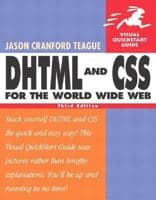
DHTML for the World Wide Web
$6.69
ISBN: 0201353415
ISBN13: 9780201353419
Formats
Conditions
A read copy, but remains in excellent condition.
Formats
Conditions
A read copy, but remains in excellent condition.
Conditions
A read copy, but remains in excellent condition.
Formats
Conditions
A read copy, but remains in excellent condition.
I've read quite a few books on DHTML and this is one of the few that I come back to over and over for solutions and ideas. The book is roughly half-and-half CSS and javascripted DHTML. Unlike many of the laughable attempts at DHTML books out there, this one focuses on effects that work in BOTH major browsers, with a chapter each on browser-specific effects. Also, unlike other books, heavy focus is placed on complete working examples with full code listings rather than hypotheticals. If you learn best tutorial-style, this book's for you.This book is not for novices at javascript. If you're new to scripting, start with Danny Goodman's javascript bible first. Likewise, know your HTML first. Most of the negative reviews written below can be ascribed to failure to read the book's notes and caveats before buying. Sure, there are a few typos, but the book's support site maintains errata and downloadable source code. And to the tosser who whines about "browser sniffing"--the list of interesting JS effects that can be created on both browsers without a bit of detection can be enumerated on one hand.
If you're not familiar with HTML then before taking on this book, read the Peachpit book on HTML. Then read this book, get the updates from the web and do all the examples - I used Netscape 4.7 and IE5. You'll be able to do quite a lot of web development after this. If you then want to delve into other areas such as Javascipt etc in more detail then get one of the more technical books around such as "Pure Javascipt".
This book carries on the excellence of Mr. Teague's book on frames. He not only explains what will work, but is very explicit in telling us what different browsers do, or don't do, with a given CSS. His instruction technique is excellent and doesn't leave the reader wondering where they got lost.If there is a weak point, it is that he doesn't stress the weaknesses of the various browsers in using style sheets. The test site he references in the appendix is informative but disturbing when Netscape and IE are both found sadly weak in some areas. The facts are clear, however, that DHTML is here to stay and this has become my main source of reference.
I was quite impressed with Jason Cranford Teague's first book (on frames) so I was excited when I learned he had written a book explaining the ins-and-outs of DHTML. He did not disappoint. I desperately needed CSS information, and his was clear and easy to follow. I will definitely use this as a reference to check on my coding.
This is a great book for developers who want to get right into DHTML. Begins with a very in-depth study of CSS, an essential component of legitimate DHTML applications. Then it gets right into the nitty gritty with examples and thorough explanations. I highly recommend this book. It's perfect for beginners, and would make a great reference for experts.