


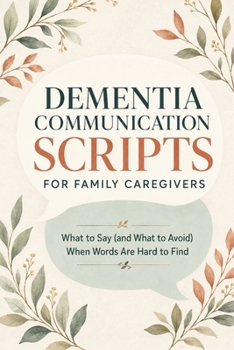
Dementia Communication Scripts: For Family Caregivers

You've tried explaining calmly. You've tried reminding gently. Some days it still ends in tears, silence, or the same question for the ninth time in an hour.
This is not a communication failure on your part. Dementia changes how a person stores and retrieves information, and the conversational habits that worked for a lifetime - reasoning, reminding, correcting - often stop working, not because you're doing it wrong, but because the tools you're both relying on have changed.
Dementia Communication Scripts for Family Caregivers gives you actual sentences for the moments that come up again and again: the repeated question, the refusal to shower, the accusation that you took something you've never touched, the request to "go home" from someone who already is. Instead of vague advice like "stay patient," you'll find specific scripts you can use almost as written, plus the reasoning behind them so you can adapt when the exact words don't fit your situation.
Inside, you'll find:
Word-for-word scripts for repeated questions, meals, medication resistance, bathing, appointments, and late-day agitationA clear framework (Calm, Acknowledge, Reduce, Engage) for handling any hard moment, built from the ground up for this bookHonest guidance on validation, redirection, and the hard truth-telling questions - including when someone asks for a spouse or parent who has diedClear, tiered guidance on when a communication approach is enough, and when a symptom means it's time to call the doctor or 911A full back-matter section of printable script cards, a personalized communication profile, and a two-week practice planEvery clinical and safety claim sourced to organizations like the National Institute on Aging, the Alzheimer's Association, and the Lewy Body Dementia Association, with full citations includedThis book won't promise a script that works every time. Nothing does. What it offers instead is a way to reduce distress, protect your own patience, and stay connected to the person in front of you, even on the hardest days.
For spouses, adult children, and anyone caring for someone with Alzheimer's disease or another form of dementia.
Customer Reviews
ThriftBooks ® and the ThriftBooks ® logo are registered trademarks of Thrift Books Global, LLC
