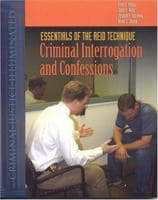
Teach your students the fundamentals of criminal interrogation and confessions with this classic text. This comprehensive text includes extensive material on the verbal and nonverbal behavior symptoms useful in distinguishing between truthful and untruthful subjects; methods for conducting non-accusatory interviews; a systematic interrogation procedure for obtaining admissions from the untruthful; an examination of the law governing interrogations and the admissibility of confessions; and an insightful discussion of problems associated with the Miranda decision.
Item was as advertised, delivered promptly, and was priced reasonably. Will continue to do business when needed.
0
★★★★★
An Excellent book for all interested in interviewing and interrogation
By Thriftbooks.com User, June 12, 2008
I have to disagree with D. Rogers that there is "no scientific approach." Just one example would be the utilization of what is called by Dr. Robert Cialdini, (Influence; Science and Practice) the Commitment and Consistency Principal. The Reid Technique encourages interrogators to never let the suspect say, "I didn't do it." The scientific studies concerning why the suspect would be more solid in his denial are clearly supported in Cialdini's new book, "Yes," and also "Freedman, J.L;, and Fraser, S.C. (1966). Compliance without pressure: The foot-in-the-door technique. Journal of Personality and Social Psychology, 4:195-203. This is just one instance of a plethura of examples I could site concerning the science involved in the Reid Technique. As for "overtly simple in style," I find nothing assaulting to my intelligence by a well written, clearly explained book. After all, the purpose of instructional books is to teach others. I give this book an A+.
0
★★★★☆
Good text...
By Thriftbooks.com User, March 13, 2007
This is a good book for anyone going into law enforcement. I had to buy it for class, but I will be keeping it because the book will be great for reference down the road!
0
★★★★☆
Criminal Interrogation and Confessions: bias and distortion at work
By Thriftbooks.com User, September 13, 2005
Old material that has been rehashed a number of times, but it is necessary to read it in order to understand the bias that is inherent in contemporary investigations. It is clearly illustrated that there is no actual scientific approach, no consideration of alternative explanations, but instead there is only an attempt to obtain confessions. Inbau, Reid, and others have never included consideration of other, more scientifically supported discussions such as those by Gudjunsson and G. Wells. The writing in the book is not very good. It is overly simple in style, and the organization is also simple, but not informative. Read the book for history and for understanding, but not for factual, supported knowledge.
0
★★★★★
Still the interrogator's Bible
By Thriftbooks.com User, April 4, 2000
Decades after its first edition, this is still considered the best work on interrogating a criminal suspect. The authors walk you through every step, towards the goal of clearing the innocent and eliciting confessions from the guilty. No detail or nuance is left unexplored, not only of the suspect's behavior, but of your own as well. This book is a must read for anyone involved in criminal justice.