Renowned astronomer Carl Sagan's classic bestseller that "dives into the past, present, and future of science, dealing with the mind-staggering enormity of the cosmos in which we exist" (Associated Press)--with an Introduction by Ann Druyan and a Foreword by Neil deGrasse Tyson"Sagan dazzles the mind with the miracle of our survival, framed by the stately galaxies of space."--CosmopolitanTHE INSPIRATION FOR THE FOX MINISERIES COSMOS: POSSIBLE WORLDS, HOSTED BY NEIL DEGRASSE TYSON AND STARRING SETH MACFARLANE AND SIR PATRICK STEWART In clear-eyed prose, Carl Sagan reveals a jewel-like blue world inhabited by a life form that is just beginning to discover its own identity and to venture into the vast ocean of space. Featuring full-color illustrations, Cosmos retraces the fourteen billion years of cosmic evolution that have transformed matter into consciousness, exploring such topics as the origin of life, the human brain, Egyptian hieroglyphics, spacecraft missions, the death of the Sun, the evolution of galaxies, and the forces and individuals who helped shape modern science. This description may be from another edition of this product.
Carl Sagan’s legacy is what inspired me to pursue a lifetime career & journey in Science, more-so discovering our place in the Universe. I 100% recommend this book, you will never regret reading a single page. An incredible Soul & gone far too soon :’)
3
★★★★★
Great!
By Rose Bryce, September 10, 2019
What a well written overview! Makes me want to read the book all over! And it's a book worthy of another read! Such a fine mind and kind heart! You don't always find the two together. What a treasure when you do! Enjoy your journey with this good man.
5
★★★★★
Carl Sagan amazes yet again
By Gabriel L Delatorre, August 19, 2019
Verified Purchase
This is a great read for novices on science and humanities history. Carl Sagan poetry on science keeps you glued to this book.
1
★★★★★
"All that is"
By Thriftbooks.com User, March 19, 2003
As one of the great astronomer-writers of the Twentieth Century, Carl Sagan was extraordinarily communicative with the non-scientific public, able and willing to take the time and trouble to break down the mysteries of the universe into comprehensible fragments. The purpose of this book, which can be considered a companion to the acclaimed television series, is to explain what we know about the universe from a cosmological perspective and why we need to know more about it.Physicists often talk of the unity of the branches of physics: the interrelation and application of mechanics, thermodynamics, electricity and magnetism, and optics to the motion of everything from galaxies to subatomic particles. Similarly, Sagan's major theme is the unity of cosmology with the natural and physical sciences that define what we know about the Earth. Does the stifling, carbon dioxide-choked atmosphere of Venus imply anything about the greenhouse effect on Earth? Was a nearby cosmic explosion called a supernova indirectly responsible for the disappearance of the dinosaurs? What would be the biological consequences for the survivors of a global nuclear war? The answers to these questions are vital to the continuation of life as we know it. Sagan also identifies cosmology with its own history. He lavishes reverent detail on the ancient Greek and Alexandrian study of the stars and planetary motions, the pioneering work by the Renaissance scientists Brahe, Kepler, Copernicus, Huygens, and others, and the men who revolutionized science with the formulation of laws of motion, Newton and Einstein.The scope of "Cosmos" is tremendous, from the farthest expanses of the universe containing a hundred billion galaxies in addition to our own Milky Way, at the end of a spiraling arm of which our solar system is located; down to the lone electron circling the nucleus of a hydrogen atom, the most plentiful single entity in the cosmos and the source of everything we know, love, and are. In between there is discussion of the unmanned spacecraft expeditions to investigate "our" planets: Mars with its boulder-strewn, desert-like terrain; the gaseous giant Jupiter; Io, a Jovian moon of incredible redness, spotted with volcanic orifices and resembling an unappealing sauce-covered meatball; Saturn with its ice rings. Would these worlds contain life? Using what we know about the evolution of life on Earth, Sagan hypothesizes how different types of lifeforms might develop on worlds with different environments. Even a casual interest in cosmology requires a fascination with astronomical distances and unthinkably long spans of time in which a human lifetime is but a blink of an eye. However, Sagan seems to write also for those who would rather relate cosmic arcana to familiar terms, and in this sense he is a grand entertainer: A thought experiment that provides a simple but fanciful illustration of the concept of black holes uses the tea party scene in "Alice in Wonderland" as
3
★★★★★
Surely one of the greatest of all books.
By Thriftbooks.com User, January 7, 2001
I first saw the series COSMOS on TV in about 1980 when I was about 12, and have been searching for similar material ever since. Carl Sagan is able to capture the mystery and the beauty of astronomy, science, art and religion in a way that most poeple can follow, and in a way that is interesting and invigorating. He is a very clear thinker and presenter. And this book, based on that very popular TV series of the same name, I found in an old book store, which I immediately grabbed. Here was something of my childhood, and something very special. The book did not disappoint. It is filled with stunning images, photographs, illustrations, diagrams and so on. And the text is fun, enlightening, clear, visionary, and precise. Not surprising, since it is written by an atronomer at heart. It is also advisable to search around and buy the illustrated edition-the illustrations add much to the text. Carl places the earth on the shores of the cosmic ocean-the title of the first chapter. He traces religious, artistic and scientific investigations into the 'cosmos' throughout the millenia, and the amount of useful historical information he brings up is quite extraordinary. He draws together the thoughts of ancient cultures like the Greeks, Babylonians, Stone Age man, Renaissance thinkers, poets, artists, and famous scientists, and ties these in with many modern discoveries concerning the nature of the universe. One can see his strong leanings on the likelihood of extraterrestial life and the SETI project between the lines, as well as his views on religion and its place in the human psyche. One particularly interesting peice describes the downfall of the old greek science and the destruction of the library at Alexandria, and how these tie in with his views on history, science and religion in general. Carl Sagan is a very clear and thoughtful writer. It is obvious that his knowledge of human nature and science is vast and humane. He worries much about the mususe of science, and the future of man. This book is a must for lovers of general science, human nature and destiny. As such it is a timeless classic. I'll close with the books closing words: "For we are the local embodiment of a Cosmos grown to self awareness. We have begun to contemplate our origins:starstuff pondering the stars; organised assemblages of ten billion billion billion atoms considering the evolution of atoms; tracing their long journey by which, here at least, consciousness arose. Our loyalties are to the species and the planet. We speak for earth. Our obligation to survive is owed not just to ourselves but also to that Cosmos, ancient and vast, from which we sprung."
3
★★★★★
Simply the best single volume about how the Earth was born!
By Thriftbooks.com User, November 6, 2000
"Cosmos" is Carl Sagan's masterpiece! He provides us with a very lucid, understandable history of the Universe and how galaxies, solar systems, planets, and our biosphere came into existence.This book reaches way out into the farthest reaches of the Universe, as well as deep within each of us explaining the DNA that makes us who we are. Carl Sagan literally touches on every known field of science as he explains how a brilliant flash of cosmic energy that was transformed into matter eventually provided the stuff needed to make you and me.I cannot recommend this book highly enough. Not only does it inform, but it truly captivates the imagination and provides the basic groundwork for future ponderings.
In what scale can we truly measure the value of a book? Ignoring how many pieces of silver we must exchange for them, the worth of books should be counted through their enrichment of our lives.
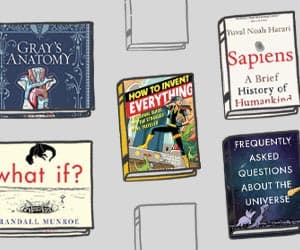
Our mini gift guides are targeted lists specific to all the unique people in our lives. Today, gifts for the science lovers and knowledge seekers in your life. From space to medicine to history to psychology, these top picks will be the perfect gift for anyone who is naturally curious.