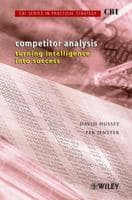
Im Gegensatz zu vielen anderen Büchern behandelt "Company Analysis" die Unternehmensbewertung als Ganzes und untersucht die zunehmende Notwendigkeit, Unternehmen als Bestandteil des fortlaufenden Strategieprozesses zu bewerten. Das Buch geht zwar von einer soliden theoretischen Basis aus, ist aber in erster Linie praxisorientiert. Es ist ein idealer Leitfaden für Senior Manager und andere Führungskräfte, die in den Strategieproze eingebunden sind. Darüber hinaus ist es auch für MBA-Studenten bestens geeignet, die sich in diesem Bereich spezialisieren wollen. Mit zahlreichen Beispielen und Checklisten.
Overall, this book is illuminating...useful even in a due diligence study!
By Thriftbooks.com User, September 23, 2007
Most businessmen & professionals are familiar with the concept of internal or position audit, better known as SWOT or SPOT Analysis in management/marketing books. To recap, the purpose of an internal audit is to appraise the strengths, weaknesses, capabilities, resources & vulnerabilities in an organisation. Personally as well as professionally, I prefer SPOT Analysis as the "Problems" in SPOT are psychologically easier to solve than the "Weaknesses" in SWOT. The latter is seemingly more inherent in the system. In this wonderful book, the author puts internal audit into the spotlight with a comprehensive book-length treatment. Probably due to space, there is only a relatively broad brush on industry analysis. What I like about the book is the broader context in which the author has put internal audit - synconvergently (thanks to Michael Gelb) with creative strategic thinking, strategic decision making & implementation. The author has dedicated one full chapter each to illustrate the key results areas to be considered in an internal audit, with a checklist of critical questions: - Finance; - Marketing; - Production; - Technology & Production; - Human Resource Management; - Management Effectiveness; - Culture & Structure; - Information Systems; The writing is crisp & clear. Examples are well illustrated. The track record of both authors, particularly David Hussey, certainly helps in making the book useful in even a due diligence study of acquisitions, mergers, strategic alliances & divestments. Overall, this book is illuminating. I would recommend this book to be read in conjunction with any of the following books, to make your appraisal of core competencies, core capabilities, critical success factors & value chains a more complete exercise: 1) 'Scanning the Business Environment', by Francis Aquilar (my personal favourite!); 2) 'Strategic Issues Management: A Comprehensive Guide to Environmental Scanning', by John Stoffels; 3) 'Information Management for the Intelligent Organisation: The Art of Scanning the Environment', by Chun Wei Joo;
0
★★★★★
HOW TO DISCOVER ORGANIZATIONAL STRENGTHS AND WEAKNESSES
By Thriftbooks.com User, June 12, 2001
This book shows how to conduct an appraisal of an organization's strengths and weakness for purposes of strategic planning that goes beyond the "ask the managers" approach. It tackles the subject in an in-depth, thorough and holistic way, providing a basic framework, evaluative approaches and guidelines, and numerous questionnaires. The major subject areas covered are: finance; marketing; production; technology and innovation; human resource management, management effectiveness, culture and structure; and information systems. The authors also take a process orientation that cuts across departments or functions, avoiding the trap of thinking that optimizing performance in each part will lead to an optimal performance of the whole. The book also explores benchmarking, comments on reengineering, and examines the value chain approach. Another approach that is explored is core competencies and their related critical success factors and core capabilities, all cutting across the whole organization. Additionally, a chapter is devoted to conducting an industry analysis. The book concludes with insights about involving managers and drawing all findings together. This book is very rare, if not wholly unique work. Well written and organized, its potential value is enormous. Very highly recommended.