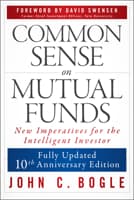
NATIONAL BESTSELLER "Cogent, honest, and hard-hitting-a must read for every investor." -Warren E. Buffett Praise for Common Sense on Mutual Funds "Invoking both Thomas Paine and Benjamin Graham, Jack Bogle outlines a supremely logical plan not only to better investors' returns, but to improve the whole fund industry. This isn't just the best book yet by Bogle, it may well be the best book ever on mutual funds." -DON PHILLIPS, President & CEO, Morningstar, Inc. "Buffett cannot teach you or me how to become a Warren Buffett. Bogle's reasoned precepts can enable a few million of us savers to become in twenty years the envy of our suburban neighbors-while at the same time we have slept well in these eventful times."-PAUL A. SAMUELSON, Massachusetts Institute of Technology Department of Economics "After a lifetime of picking stocks, I have to admit that Bogle's arguments in favor of the index fund have me thinking of joining him rather than trying to beat him. Bogle's wisdom and his commonsense way of explaining things make this book indispensable reading for anyone trying to figure out how to invest in this crazy stock market."-JAMES J. CRAMER, Money Manager and Senior Columnist for TheStreet.com "Written in his characteristic forthright and visionary style, Bogle penetrates the myths and jargon to shed a powerful light on the central issues that confront every investor, no matter what their level of experience or sophistication." -MARTIN L. LEIBOWITZ, Vice Chairman and Chief Investment Officer, TIAA-CREF "Jack Bogle is one of the great pioneer/visionaries of the investment business. In this book, he shares his knowledge, experience, and judgment to enable us to become better investors. The final philosophical chapters provide insights that may help some of us become better people." -BYRON R. WIEN, Chief U.S. Investment Strategist Morgan Stanley Dean Witter
Despite the prosaic title of the book, and the conservative investment philosophy of its author, "Common Sense on Mutual Funds" has a revolutionary aim. Vanguard founder John Bogle believes the mutual fund industry must make major changes in order to faithfully serve its customers and, by explaining his investment philosophy, he shows both why radical change is necessary for the industry and helps to precipitate it by encouraging individual investors to follow his investment advice. Bogle thinks too many mutual fund investors are being scammed by professional managers of funds who reward their companies instead of their investors' portfolios. High fees, outrageous expenses, rapid turnover, unneeded "products", marketing costs -- all are used by countless mutual fund companies to inflate their bottom lines to the detriment of their investors' needs.Several reviewers here have noted that Bogle repeats several key points throughout the book, especially the importance of keeping costs as low as possible. This is true. But important lessons need to be stressed, especially with so much evidence that the average investor still doesn't understand them. Perhaps Bogle feels it's a lesson that can't be said enough. After all, why would you pay more for less, unless you simply don't understand what is being done to you?This book was somewhat prescient. Published near the end of the long bull market of the 1980 and 90s, "Common Sense on Mutual Funds" called out -- in its own quiet and understated way -- for reform of the mutual fund industry before it became fashionable to do so. While Bogle's book doesn't have an angry tone, its recommendations are essentially more radical than anything now being considered by New York's attorney general in his drive to reform the industry.
1
★★★★★
Essential content if you own mutual funds
By Thriftbooks.com User, June 30, 2002
John C. Bogle founded Vanguard, the premier indexed mutual fund company. If you invest in mutual funds, especially if you invest in managed mutual funds, you must read this book. He reveals his intensely compelling case for passive management of funds (ie indexing) versus active management (ie stock-picking, market-timing, hot-manager style) funds.Most people these days hold the bulk of their investment assets in pension funds, IRAs or 401Ks usually consisting of mutual funds, and this audience will gain significant insight from Bogle's advice. Bogle also campaigns to save the mutual fund trader from herself, relentlessly presenting the mutual fund as a buy-and-hold investment vehicle.Those who have read a few other books on investing may find Bogle's single-mindedness and thoroughness a bit tedious. I found myself skimming for content throughout the book and especially after the first 14 chapters, finding the later material more visionary and less relevant to my investing. A good editor could probably reduce the bulk of the text by a half or two-thirds and retain the central ideas.By the way, you can get much of this material (for example, the chapter on bond funds) from the Vanguard web site under the "Bogle Lectures." All the ideas are there - they're what the company is based on. Save a few bucks - reduce your investing costs - "costs matter" as Bogle will tell you again and again.
0
★★★★★
One of the best on mutual funds
By Thriftbooks.com User, May 17, 1999
It took me years to finally figure out that "passive" investing in mutual funds is the absolute best way to build a retirement fund. Mr. Bogle has an intimate relationship with index funds because he, via Vanguard, blazed the path when all others doubted indexing. As a CPA and MBA and CFP to boot I have spent a fair amount of time and effort trying to "beat the market" only to learn that matching the market is the best strategy for the long haul. Had I simply invested according to his precepts I would have parlayed a lot more money with a lot less effort. It IS a hard book to read for those not used to technical terms. But "stay the course" as John would say, and you (and your money) will be amply rewarded.