A solid introduction to geometry that emphasizes learning through problem solving
By Thriftbooks.com User, July 3, 2007
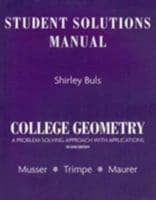
One of the problems a number of math students face is learning how to think about the problems they face. They simply never develop the necessary tool set that will allow them to understand what the problem is asking and what they should do to attack it. Once they have an answer, they are not sure if they have found the correct answer. This is a fine BASIC text for college and high school students who want to get a handle on dealing with geometry. If you have a deep mathematics background and are looking for an advanced college text on geometry, this is probably not for you. However, if you want to learn the basics on how to think about geometry and a lot of help on how to solve a variety of geometric problems, this is a terrific text and will be a big help. I enjoy the way the text engages the student from the very beginning and asks him or her to THINK. It isn't a bunch of material to memorize. What the authors do is build the student's understanding through problem solving. If the student will take the time to work the problems and not give up on the problems he or she finds difficult, the understanding will come and will be more ingrained in his or her thought processes than would happen through memorization. There are lots of geometric drawings, as one would hope, and there are a number of applications of geometry to real life and that should help the student, as well. Again, this is meant as a basic geometry text and can be suitable for a good high school student as well as non-majors in college that want to get an introduction to the basics of geometry.
1
★★★★★
An outstanding introduction to geometric thought
By Thriftbooks.com User, October 4, 2000
This is one of the few introductory level texts I have seen that gives some of the real flavor of mathematics, without being too challenging for beginning students. The initial section on problem solving is modelled on the famous book by Polya, "How to solve it," and has many simple but thought-stimulating problems. The following sections develop plane and solid geometry with many illustrated problems and interesting historical notes. The final chapters carefully introduce geometric proofs. There are also review sections on simple algebraic manipulations and basic logic, as well as a short section on the implications of alternate parallel postulates. Overall, the text has a well thought out development of basic skills and concepts, and enough interesting tidbits from more "advanced" topics to challenge the imagination of any student.