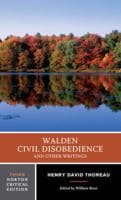
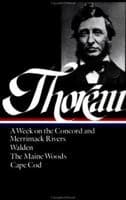
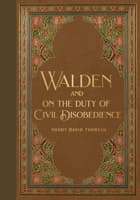
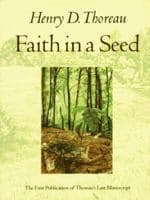
Philosopher, naturalist, poet and rugged individualist, Henry David Thoreau (1817-1862) has inspired generations of readers to think for themselves, to follow the dictates of their own conscience and to make an art of their lives. This representative sampling of his thought includes five of his most frequently cited and read essays: "Civil Disobedience," his most powerful and influential political essay, exalts the law of conscience over civil law. "Life without Principle" distills the essence of Thoreau's philosophy of self-reliance and individualism. "Slavery in Massachusetts" is a searing attack on government condonation of slavery. "A Plea for Captain John Brown" is an eloquent defense of the radical abolitionist, while "Walking" celebrates the joys of that activity and pleads for conservation of the earth's wild places. The latter essay is recognized as one of the pioneer documents in the conservation and national park movement in America.
""How vain it is to sit down to write when you have not stood up to live,"" Henry David Thoreau once observed. The American poet, essayist and philosopher certainly held himself to that standard -- living out the tenets of Transcendentalism, recounting the experience in his masterpiece, Walden (1854), and passionately advocating human rights and civil liberties in the famous essay, Civil Disobedience (1849).
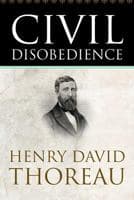
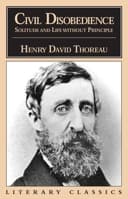
(Original Title: Resistance to Civil Government) I knew that Henry David Thoreau was a tax evader; however, I did not realize how radical he was until I read his book on the duty of civil disobedience. He starts with "The government is best which governs not at all." This should have tipped me off to what was going to come next. What would Timothy McVeigh think if he had read this (and he might have): "Unjust laws exist: shall we be content to obey them, or shall we endeavor to amend them, and obey them until we have succeeded, or shall we transgress them at once?" Henry David Thoreau's discussion of democracy verging on mob rule or only majority rule could have also incited certain well-known people. If you put your hand over the title and read the sentences, they could've been dropped into "Mein Kampf" and fit very well. The bottom line in his dissertation is stated: "There will never be a free and enlightened State until the State comes to recognize that individual as a higher and independent power, from which all its power and authority are derived, and treats him accordingly."
0
★★★★★
When the State is Unjust
By Thriftbooks.com User, March 6, 2010
Civil Disobedience (Original Title: Resistance to Civil Government) by Henry David Thoreau (1817-1862) This essay was written at a time when slavery was still legal and the United States military had invaded Mexico, serving as a catalyst for Thoreau's dissent against an unjust government. His focus is on the primacy of the individual - and he disagrees that the individual should "serve" the State, especially when the state is unjust. Some of his memorable quotes include: -- The mass of men serve the State thus, not as men mainly, but as machines, with their bodies. -- (The state) is not armed with superior wit or honesty, but with superior physical strength. I was not born to be forced. -- When I meet a government which says to me, "Your money or your life," why should I be in haste to give it my money? Ironic as it seems, what was written by Thoreau about the Congress in 1849 is still true today: "Our legislators have not yet learned the comparative value of free trade and of freed, of union, and of rectitude, to a nation. They have no genius or talent for comparatively humble questions of taxation and finance, commerce and manufactures and agriculture. If we were left solely to the wordy wit of legislators in Congress for our guidance, uncorrected by the seasonable experience and the effectual complaints of the people, America would not long retain her rank among the nations." Thoreau concludes that "there will never be a free and enlightened State until the State comes to recognize the individual as a higher and independent power, from which all its own power and authority are derived, and treats him accordingly." This could serve as a primer for the Tea Party Movement! Dr. B Leland Baker, author of Tea Party Revival, The Conscience of a Conservative Reborn Tea Party Revival - The Conscience of a Conservative Reborn: The Tea Party Revolt Against Unconstrained Spending and Growth of the Federal Government
0
★★★★★
excellent
By Thriftbooks.com User, April 6, 2009
Thoreau's writing on "Duty of Civil Disobedience" is brilliant! I have LONG been a fan of the writings of HDT and once journeyed to Walden to see the cabin he lived in but a brief time. This book is so often cited as required reading among those who advocate non-violent protests. While I clearly see why it provides useful information for these purposes, I found myself disappointed by the rustic, "whiskey-rebellion" kind of thinking of anti-taxation given that he also advocates the reader's taking benefits from the state. I'm now conflicted. I find the writings and man a genius, even in those instances in which I disagree with the extent of his anti-taxation position.
1
★★★★★
Take back your power
By Thriftbooks.com User, March 19, 2007
Though many statements Thoreau has made seem a little flakey around the edges, when it came to free will and individual choice he had the right idea and the courage to see it through. The importance of centralizing power within oneself is perhaps more important today than ever when unrestrained government in partnership with multinational corporations weild enormous destructive power. A book that has not lost its relevance.
2
★★★★★
". . . the most American of us all"
By Thriftbooks.com User, October 30, 2001
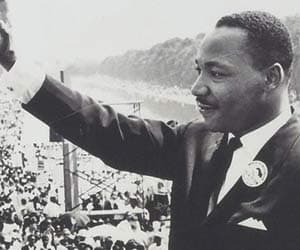
Henry David Thoreau (1817-1862), in his essays, expressed a point of view which continues to be relevant not only in the United States, but in any society that values civil liberties and democratic ideals. "Civil Disobedience and Other Essays," from Dover Publications, brings together the title essay along with four other pieces: "Slavery in Massachusetts," "A Plea for Captain John Brown," "Walking," and "Life Without Principle."Reading Thoreau's work, I was struck by how much some of his ideals are echoed by a later United States activist: the Rev. Martin Luther King, Jr. Thoreau was passionately opposed to slavery. He also cast a critical eye on the concept of majority rule, and was concerned about the place of a minority within an unjust system of laws. He has some noteworthy thoughts on the U.S. Constitution.Thoreau is not just a "theoretical" radical; in the title essay he reflects on a night he spent in jail as a result of his civil disobedience (that event inspired the excellent play "The Night Thoreau Spent in Jail," by Jerome Lawrence and Robert E. Lee). Thoreau's voice is still strong after all these years, and deserves to be heard by contemporary audiences. One final note: In his defense of the militant abolitionist John Brown, Thoreau describes Brown as "the most American of us all." I think that such a description also fits Thoreau himself.
2
★★★★★
Begone Socrates...
By Thriftbooks.com User, April 23, 2001
This book is not only great unto itself, but it is a phenominal counterpoint to Socrates' Crito. Socrates speaks about our supposed contractual duty to obey the law, no matter what the laws say; Thoreau stands for no such thing. We would never buy into anything that aimed to harm us, and this book explores such a notion. On its own, this book is fantastic. Coupled with the Crito, you get an interesting look at whether or not civil disobedience is acceptable.
1
Resistance to Civil Goverment (Civil Disobedience) Mentions in Our Blog
This week marks the anniversary of Martin Luther King’s eleven-day imprisonment in Birmingham Jail. The treatise he wrote there became an important touchstone for the American Civil Rights Movement. But this is only one of many great works written within the confines of a cell.