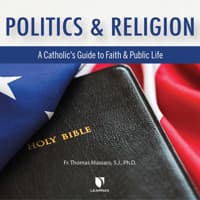
How can you live out the Gospel's message of social justice in the modern world? Both the Old and New Testaments are rich with tales of justice and injustice, and yet religion is often portrayed as a private affair of the heart. This series gets to the heart of social engagement and the Christian tradition. The Gospels call all Christians to work for justice, even in times of conflict. Under the guidance of celebrated moral theologian Fr. Tom Massaro, you will come to understand the dialogue between religion and society. As you do so, you will gain a deep understanding of the history and application of Catholic social teaching. Discover new developments in Catholic social teaching, which elucidate the movement from a "charity alone" orientation to a "charity plus justice" approach. You will also explore the sources of Catholic social teaching: Scripture, reason, tradition, and experience. The documents of Catholic social teaching promote strong stances on family, human labor, poverty, government, the environment, and war. You'll explore a three-step model that will help you to connect abstract principles of social teaching to the world's concrete realities. Catholic social teaching connects faith to the topics that affect us the most in our daily lives. Deeply rooted in thousands of years of tradition and Scripture, Catholic social teaching serves to teach us more about the world we live in, how to help the people around us, and how to better ourselves as Catholics. This description may be from another edition of this product.
Highly readable study of Christian ethics and public policy
By Thriftbooks.com User, April 20, 1999
Father Massaro is a professor of ethics at a Jesuit theological school, and shows full command of his subject. Better yet, his writing style is very clear and accessible to the average reader. When it becomes necessary to use specialized theological or philosophical terminology, he is always careful to give the reader a lucid explanation. Moreover, in the course of his career he has had a great deal of exposure to other Christian denominations (his Ph.D in ethics is from Emory, a Methodist university, and the Jesuit institution at which he currently teaches shares facilities with an Episcopal divinity school). This also shows in his writing. He writes for an audience that may not be familiar with the basic premises behind Roman Catholic social teaching.Massaro does a masterful job of outlining his church's position. At its most basic level, it is what Christians of all stripes believe: that they must love their neighbor, in part through sharing their wordly possessions with those less fortunate than they. Exactly how one is to obey this stricture is where the real debate begins.Advocates of welfare reform stress the need to foster a sense of responsibility among recipients by setting time limits and instituting work requirements. In their view, welfare is to be a temporary emergency measure, not a long-term way of life. While Massaro finds this to be a laudable goal in theory, he is worried that, in reality, people who are really unable to fend for themselves (especially children) are being shunted aside by society. Thus, he is a stern critic of current policy.This is a well-researched book, with a great deal of statistical citations. Nonetheless, in advocating a more welfarist, European model for the U.S. economy, he ignores some of its key deficiencies, such as the disincentives it gives people to seek employment and companies to expand their payrolls.But then, this book is useful in sparking debate. Even if you disagree with the author's prescriptions, he does an excellent job of getting you thinking.