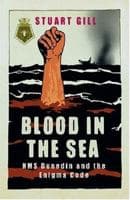
This harrowing tale of survival pays moving tribute to the courageous British sailors of World War II, and offers entrance into the ultra-secret world of British code-breaking. In November 1941, the British light cruiser "HMS Dunedin" was patrolling the shipping lanes of the central Atlantic, directed to its targets by British intelligence agents who had cracked the German "Enigma" code. On November 24, a torpedo from a German U-boat sent her crashing to the ocean floor, along with over 400 of her crew. For three days, 72 desperate survivors clung to the flotsam, fighting off swarming sharks and pounding waves until an American ship stumbled across the scene. This description may be from another edition of this product.
Naval stories do not get more gripping than the tragedy of HMS Dunedin, a British light cruiser sunk by a German U-boat in 1941, and seldom are the stories better told than the one related in Blood in the Sea: HMS Dunedin and the Enigma Code. The author Stuart Gill uses the experiences of his father, Marine William Gill, one of only sixty-seven survivors (out of 486 crew and officers) to construct a history of the ship, and the result is one terrific read. The ship had seen twenty-four years of fairly ordinary service (in the words of Gill's father, the cruiser "was a bit player on a large stage") when it went down far off the Central Africa coast. Broken by two torpedoes fired from U-124, the Dunedin sank so quickly that over 200 men were trapped below. The ship had no time to report its position--or even that she was going down. There was not enough room in the seven rafts for all those still alive. Those still in the water soon realized they were surrounded by sharks. The tropical air temperature was unmercifully hot. There was no water. There was no food. The rafts were taking on water. These sailors knew they were as alone as men had ever been on the sea. The moment called for ordinary men to become something extraordinary.
0
★★★★★
Poignant Tale of World War 2 and Modern Memory
By Thriftbooks.com User, April 7, 2004
Author Stuart Gill succeeds in doing something very rare among the thousands of WW2 books in print: juggle several points of view to tell a fast-moving story of a largely unknown tragedy. Like a good film director, Gill cuts back and forth between the British warship on patrol, the British cryptographers using the captured Enigma code to track the enemy's moves, and the German U-boat that is first hunted, then becomes hunter. The tragedy that ensues is simply and unsparingly presented. The reader is then cast forward in time to share the heartbreak of loved ones as they receive the news and live with the loss for decades to come. No reader can be untouched by the passage of the young woman who lost her fiance on HMS Dunedin only to find, years later, the love poem he marked just for her. Although the war action of the book is during the 1940-41 period when Britain stood alone, American readers will appreciate Blood in the Sea for the way history often throws us signs. The survivors of HMS Dunedin are picked up by an American merchant ship on Thanksgiving Day, 1941. Those survivors were disembarked at a friendly port on Sunday December 7th. Anglo-American friendship was to endure.