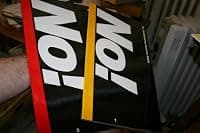
Prior to the 1960s, art objects were viewed as wholly distinct from non-art. But by mid-decade, that perspective was being challenged by artists such as Andy Warhol, whose Brillo Boxes looked exactly like the real ones; Roy Lichtenstein, whose paintings imitated comic book pages; and Carl Andre, whose floor sculptures were, in fact, slabs of industrial metal. Art and Context examines how these pieces and others like them relate to a society bombarded by advertising while also in the midst of a cultural revolution--as evidenced by the growing acceptance of civil rights, feminism, drug use, and sexual freedom--and offers a solid basis for understanding the art of the past half century.
"Art & Context: The `50s and 60s" focuses upon artistic creations by twenty of postwar America's most influential artists ranging from Alexander Calder, Willem de Kooning, and Roy Lichtenstein, to Robert Motherwell, Jackson Pollock, and "Andy Warhol. The two decades of 1950 and 1960 saw the rise of an American counterculture with its new social, sexual, racial, and artistic freedoms. Historical context and analysis are provided by essays by Chris Bruce (Director of the Museum of Art, Washington State University, Pullman), Nella Van Dyke (Associate Professor of Socilogy, Washington State University, Pullham), and Keith Wells (Curator of Exhibitions and Collections,l Museum of Art, Washington State University, Pullham). "Art & Context" is a work of impeccible scholarship and a welcome, seminal contribution to personal, professional, and academic library `Art History & Criticism' reference collections and supplemental reading lists