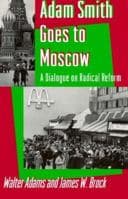
Is it the central purpose of American antitrust policy to encourage decentralization of economic power? Or is it to promote "consumer welfare"? Is there a painful trade-off between market dominance and economic "efficiency"? What is the proper role of government in this area? In recent years the public policy debate on these core questions has been marked by a cacophony of divergent opinions--theorists against empiricists, apostles of the "new learning" against defenders of the traditional structure-conduct-performance paradigm, "laissez-faire" advocates against "interventionists." Utilizing a distinctively innovative format, Walter Adams and James Brock examine these issues in the context of a courtroom dialogue among a proponent of the new learning (Chicago School), a prosecuting attorney, and a U.S. district judge. In contrast to bloodless "scientific" treatises or ideologically inspired polemical tracts, this book lays bare the central arguments in the debate about free-market economics and the latent assumptions and disguised terminology on which those arguments are based. The dialogue is both gripping and entertaining--designed by the authors to be reminiscent at times of the Theater of the Absurd. Originally published in 1991. The Princeton Legacy Library uses the latest print-on-demand technology to again make available previously out-of-print books from the distinguished backlist of Princeton University Press. These editions preserve the original texts of these important books while presenting them in durable paperback and hardcover editions. The goal of the Princeton Legacy Library is to vastly increase access to the rich scholarly heritage found in the thousands of books published by Princeton University Press since its founding in 1905.
After reading the back cover and introduction of this book, I expected a rather harsh portrayal of neoclassical economics. This book does not end up being too crtical of the Chicago school. Of course there are a number of strawmen in this book, portions where the expert is portrayed as an out of touch academic oblivious to the effects of his theories. Perhaps my greatest criticism of this book is that it does not adequately exlore the "sovereign's charter" - the government maintained monopolies. The authors refer to the concentration in the airline industry without really considering the effects of regulation that excluded foreign airlines from domestic routes. In addition, the authors do not seem to commit enough attention to the availability of substitutes for virtually any commodity or service. Even if the major airlines offer fewer flights from a particular airport in the long run smaller air lines will establish routes. If not, there are alternatives like high speed rail. At the exteremes, one could consider technological advances like teleconferencing and electronic data exchange reduce the need for certain forms of business flights. Overall, however, the book only takes a few hours to read and introduces the major debates of this subject.
0
★★★★☆
Interesting, open-ended
By Thriftbooks.com User, September 9, 1998
This is the same topic the authors have tackled in their other books, this time presented in a somewhat screenplay-ish format. Once again it is an argument between theory and evidence. As you read the discussion between the lawyer and the economist you wonder why the economist always retreats to theory in the face of evidence. It would interesting to hear a Chicago economist's explanation of the facts Adams and Brock bring to bear.