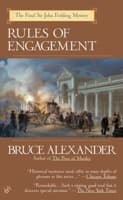
Consistently hailed as wonderful (The New York Times Book Review), the Fielding mysteries combine period ambiance, vivid characterization, and intriguing plotlines. In this story, a packet of incendiary letters is stolen from a prominent official and turns up in the colony of Massachusetts. Why has a suspect in the theft turned up dead?
#9 Sir John Fielding mystery in which Jeremy and Sir John become involved in a plot involving Benjamin Franklin and the American colonies. Someone has stolen a packet of letters from the home of a prominent member of Parliament, believed to be damning to certain British officials with regard to the rights of the Colonials. A footman was brutally coshed on the head and killed during the burglary, therefore it's a murder case as well. Mr. Franklin is high on the suspect list as having hired certain thugs to perform the deed, but without proof, Sir John and Jeremy are stuck at a standstill. Several changes are in the works with regards to secondary characters as well, as the Fieldings' former cook, Annie, stars in a production of Romeo and Juliet, Molly (the new cook) settles in and is courted by Dr. Donnelly (the medical examiner) and Jeremy and Clarissa's relationship begins to change. Enjoyable entry in the series as always; the author's notes indicate that he played fast and loose with known historical fact in this book with regard to Ben Franklin's involvement, but I thought he did it very well. It *is* historical fiction after all!
0
★★★★★
Brit view of outrageous colonists
By Thriftbooks.com User, January 20, 2003
Though not his best in the outstanding Sir John Fielding series, Alexander?s ninth provides a lively view of British outrage and bafflement at the fractiousness of the American colonies as well as a rich portrait of crime and policing in 18th century London as the blind Bow Street Court magistrate Fielding oversees his Bow Street runners and investigates a murder/robbery with ominous political overtones. Young narrator Jeremy Proctor, Fielding?s eyes and legs and increasingly mature assistant, tells the tale with verve, initiative, and wit, indulging in a little romance of his own along the way.The case involves the theft of inflammatory letters and the collateral murder of a footman at the home of an arrogant British lord, secretary of state for the American colonies. Though Lord Hillsborough refuses to divulge the letters? contents, it?s clear they connect with the rising colonial foment. Dinners with Samuel Johnson and Benjamin Franklin speed Fielding?s cogitations while Jeremy scouts the back alleys and low taverns for the hired miscreants. The central mystery is a bit weak, but it hardly matters as Alexander brings history to life from the perspective of those making it and Jeremy continues to charm and provide the action, from disarming a mob to battling a ruthless assassin. Franklin appears in all his warts and brilliance and only the British aritsocracy comes off worse. Well-written, atmospheric and intirguing, the series continues to delight.
0
★★★★★
Outstanding historical series
By Thriftbooks.com User, December 31, 2002
Most series go into a decline long before they reach the ninth installment. Not so with Bruce Alexander's wonderful creation. This latest volume is my personal favorite thus far. The characters and richness of period detail would be enough to make the books worth reading, even without the mystery plots. The characters have become like old friends. The books have an appeal much like Sherlock Holmes, which make you want to visit just for the atmosphere and interaction among the characters. Jeremy is back, but alas, he has outgrown his green coat. Sir John is as formidable and perceptive as always. Bruce Alexander has the ability to include actual historical figures (Ben Franklin in this case) without seeming contrived. Since the plot has already been summarized, I will only add that these books are worth buying--in hardback--because you will want to re-read them and pass them to friends. I hope this series continues, because I am hooked!
0
★★★★★
At The Top Of His Game
By Thriftbooks.com User, November 4, 2002
This series has replaced Anne Perry's series as my choice for the best historical detective fiction around. The mysteries are always tightly plotted and believable and the characters, from the stars to the supporting players, are intricately drawn and unforgettable. These books are just a tremendous reading experience.
0
★★★★★
excellent period piece
By Thriftbooks.com User, October 11, 2002
He may be blind but Sir John Fielding is regarded as one of the most intelligent magistrates in 1793 London. He presides as a judge in court and leads investigations on matters that are sensitive to England's interests. Lord Hillsborough, the Secretary of State for the American Colonies, is robbed and one of the footmen is dead. He tells Sir John that he has no idea what the burglars were after but the magistrate doesn't believe him.After he reports to his superior, Sir John is ordered to once again visit Lord Hillsborough who promises to be forthcoming. He says a packet of letters were stolen but he won't say how many or what was in them. Sir John's assistant, Jeremy traces the purloined letters to Ben Franklin and his confederate Arthur Lee. The latter is seen boarding a ship heading to the colonies and Jeremy presumes the letters are on board. Sir John is really not interested in the politics but he is interested in justice and will do all in his power to see the killer go to jail no matter who it is.It is fascinating to read about the English perspective on the troublesome English colonies and how far radicals will go in support of their solution. Bruce Alexander is a fine storyteller and the historical detail he brings to the plot only enhances the quality of AN EXPERIMENT IN TREASON. Readers will continue to read the Sir John Fielding mysteries because they are excellent period pieces.Harriet Klausner