


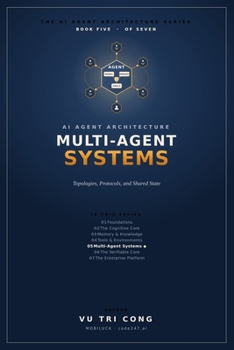
AI Agent Architecture: Multi-Agent Systems: Topologies, Protocols, and Shared State — Agents Behind Contracts, Versioned Messages, a Blackboard over ... and Human (The AI Agent Architecture Series)

The workers may guess. The supervisor may not.
Atlas, Meridian Supply Co.'s customer-operations agent, acted through one door by Book 4. Then a reorganisation drew a line through it, and the split that took a day paged the other team at 07:40 with a KeyError in code nobody had changed. This book is what a team of agents needs that a single agent does not - and it builds each piece from an incident, prices it in a table, and proves it with a test.
Every chapter is a lab on the companion repository - one dependency, fully offline with a scripted mock, every listing printed from a verified line range, every command paired with its expected output. Five moves per chapter: Run the demo, Read the listing, Break it with the chapter's planted failure, Fix it with the design move, Prove it with a test that turns green. You will:
Split Atlas into agents on a wire and read the bill - same answers, same model cost, plus hops, kilobytes, and latency - then put a contract on the seam so a rename is refused by nameRun the same four agents as a pipeline, under a supervisor, and as a network, and choose the shape from a table with the column pictures hide: how many places must be asked to find a ticketGive every message a typed, versioned schema; diff a proposed version and read which peers it breaks; adapt and negotiate between versionsFold a blackboard from an append-only event log, replay it to the digest, travel to event forty-nine, and catch the write that went behind the logMake the supervisor deterministic code and measure it: the same inbox routed a thousand times, one trace - against a model in the routing seat, a thousandRoute by a capability registry the agents write; add a specialist with zero orchestrator edits, and prove the zero with a digestReproduce a double claim and a lost update with a deterministic scheduler, and cure them with an atomic claim and a three-way mergeInstrument the team, catch a ping-pong loop at hop six, and stop a retry storm with a circuit breaker - and measure why retries in two layers multiplyPut people in the topology as nodes with queues, checks, authority, and SLAs; simulate three rosters on the team's worst week and read the breachesAssemble Atlas v0.5 and prove it on outcomes in the world - mail, CRM, refund - with an org chart that is the architecture diagramEvery chapter carries a research lineage (Conway and microservices, Contract Net and Wooldridge, FIPA-ACL and A2A, Hearsay-II and event sourcing, workflow determinism, service discovery and Team Topologies, two-phase locking and CRDTs, Perrow and the flash crash, mixed-initiative and queueing), a five-item failure catalog, an applied deep-dive, and exercises in three tiers. Ten figures, 246 tests, forty-four decision records
Who it's for: engineers scaling from one agent to a cooperating team - anyone who has drawn boxes and arrows for agents and wants to know what each arrow costs, who decides where a message goes, and how to prove afterwards what the team did. Assumes Books 2-4 or the equivalent; basic Python; no framework, no GPU.
The AI Agent Architecture Series is the architect's track: one architectural layer per book, on one running system the reader refactors and grows by hand. This is Book 5, Multi-Agent Systems - the team, designed and proved.
Customer Reviews
ThriftBooks ® and the ThriftBooks ® logo are registered trademarks of Thrift Books Global, LLC
