


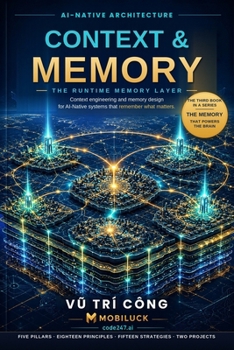
Context & Memory Engineering: Five Pillars for the Runtime Layer of AI-Native Systems

Your AI assistant forgets everything. Every conversation, every preference, every decision - gone the instant the call ends.
Large language models are stateless by design. Everything an AI system appears to "remember" - the case discussed last week, the user's preferences, the plan agreed an hour ago - is engineered, deliberately, outside the model. That engineering layer decides what enters the context window on every single turn, and it is where AI systems quietly succeed or silently fail.
This book teaches you to build that layer properly.
While most teams throw bigger models and bigger windows at the problem, quality keeps degrading: context rot, lost-in-the-middle, cross-user memory leaks, agents that drift off course after twenty steps. The root cause is almost never the model. It is an unmanaged context and memory layer - and this book gives you the complete discipline to fix it.
Inside, a full engineering system:
The Five Pillars - Direction & Token Budget, Memory Tiering, Selection & Assembly, Writing & Consolidation, and Forgetting, Freshness & Safety - expanded into eighteen working principles
Fifteen practical strategies, from sliding windows and compaction to agentic memory and hybrid tiered architectures, with a decision tree for choosing among them
A seven-step design process that takes you from problem statement to a running, measurable system
Five hands-on design guides: window assembly, memory store design, compaction & summarization, retrieval-for-memory, and lifecycle & governance
Two complete end-to-end projects at opposite poles: an enterprise multi-tenant agent copilot, and a personalized tutor that remembers one learner across weeks
Fourteen anti-patterns mapped to the pillars they violate - a diagnostic chart for when your system "answers poorly for no clear reason"
A measurement framework: ten quality criteria, concrete metrics, golden task sets, and a directed improvement loop
Every chapter ends with a self-check quiz. The appendices pack a glossary, cheat-sheet, a 100+ item design checklist, a 100+ entry pattern library, and starter templates for developers, business analysts and AI engineers.
Book 3 of the AI-Native Architecture series. Book 1 covered RAG - exploiting knowledge. Book 2 covered Knowledge Graphs - constructing knowledge. This volume operates the layer where both converge: seen from here, RAG is long-term semantic memory, the knowledge graph is structured memory, and the quality of any agent is upper-bounded by the context and memory layer it stands on.
If you build AI systems that must remember what matters - this is the missing manual.
Customer Reviews
ThriftBooks ® and the ThriftBooks ® logo are registered trademarks of Thrift Books Global, LLC
