Skip to content
ISBN: 0811200329
ISBN13: 9780811200325

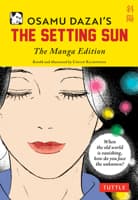
The Setting Sun

$9.79List Price: $14.95
Save $5.16!
ISBN: 0811200329
ISBN13: 9780811200325
Formats

Conditions

An apparently unread copy in perfect condition.

Formats

Conditions

An apparently unread copy in perfect condition.

See all 24 editionsfrom $7.89

Book Overview

Set in the early postwar years, it probes the destructive effects of war and the transition from a feudal Japan to an industrial society. Ozamu Dazai died, a suicide, in 1948. But the influence of his book has made "people of the setting sun" a permanent part of the Japanese language, and his heroine, Kazuko, a young aristocrat who deliberately abandons her class, a symbol of the anomie which pervades so much of the modern world.
Format:
Paperback
Language:
English
ISBN:
0811200329
ISBN13:
9780811200325
Release Date:
January 1968
Publisher:
New Directions Publishing Corporation
Length:
174 Pages
Weight:
0.64 lbs.
Dimensions:
0.5″ × 5.2″ × 8.0″
ClassicsContemporaryFictionLiteraryLiterature & Fiction

More by Osamu Dazai

The Columbia Anthology of Modern Japanese Literature: Volume 2: 1945 to the Present
M�a�s�a�o�k�a� �S�h�i�k�i� �, Taiko Hirabayashi, Junzaburo Nishiwaki, Yoshinori Shimizu, Kafū Nagai, Shinobu Origuchi, Ryūnosuke Akutagawa, Mokutaro Kinoshita, Hiromi Itō, Ōgai Mori, Katsue Kitasono, Zenmaro Toki, Tatsuo Hori, Kazue Shinkawa, Takeshi Kaikō, Kazuko Shiraishi, Taruho Inagaki, Fumiko Hayashi, Yoshikichi Furui, Nobuo Ayukawa, Shōhei Ōoka, Kōyō Ozaki, Yuzuru Katagiri, Shin'ichi Hoshi, Haruki Murakami, Masuji Ibuse, Takuboku Ishikawa, Kagai Kodama, Junji Kinoshita, Juro Kara, Mokichi Saito, Shigeharu Nakano, Kenji Miyazawa, Taeko Tomioka, Yōko Tawada, Mieko Kanai, Shuntarō Tanikawa, Shinpei Kusano, Naobumi Ochiai, Yukio Mishima, Nobuo Kojima, Kenji Nakagami, Akiko Yosano, Rin Ishigaki, Tatsuzō Ishikawa, Kōbō Abe, Doppo Kunikida, Yūko Tsushima, Hisashi Inoue, Kenzaburō Ōe, Hagoromo Takeshima, Denji Kuroshima, Hakushū Kitahara, Yasushi Inoue, Edogawa Rampo, Keiichirō Hirano, Hyakken Uchida, Fumiko Enchi, Jun'ichirō Tanizaki, Akiko Baba, Taijun Takeda, Minoru Betsuyaku, Kotaro Takamura, Osamu Dazai, Kanoko Okamoto, Hiroshi Noma, Kunio Kishida, Tsuyoshi Shima, Kyōka Izumi, Tota Kaneko, Naoya Shiga, Hideo Kobayashi, Yoshie Hotta, Shūsaku Endō, Santōka Taneda, Natsume Sōseki, Shōtarō Yasuoka, Machi Tawara, Takako Takahashi, Yasunari Kawabata, Hisajo Sugita, Taeko Kōno, Tōson Shimazaki, Sakutarō Hagiwara, Hakuchō Masamune, Sawako Ariyoshi, Banana Yoshimoto, Yōko Ogawa, Ango Sakaguchi, Hideo Oguma, Minoru Yoshioka, Fumiko Nakajō, J. Thomas Rimer, Van C. Gessel
from: $55.00

Customer Reviews

12 customer ratings | 5 reviews
Write a Review

Beware The Snake

The Setting Sun centers around a woman dealing with her dying mother and self-destructive brother, in addition to her own spiritual disillusionment in post WWII Japan. Unlike Dazai's No Longer Human, the central character here, Kazuko, seems to suffer from an emptiness and longing different (and somehow more feminine) then the nihilism in No Longer Human. She tries, but ultimately cannot find solace anywhere. Her family is dissolving. She persues a lover she knows will not fulfill her. She feels uprooted from her aristocratic life in her new country home. Disturbing omens are weaved throughout the story as tragedy surrounds her. Even the world of art and politics are viewed as being superficial and intellectually unstimulating. In the end (similar to No Longer Human) Dazai poignantly closes the story with a life affirming conclusion. His ability to capture a subtle complexity with Kazuko's emotions and actions make this slim, deceptively simple novel into a multi-layered masterwork.

3

Outstanding view of Post WWII Japan!

"The Setting Sun" provides a view of post-war Japan that few can portray as effectively as Osamu Dazai can. I had not previously read his books, but I came upon this one in conjunction with a college assignment. The emotions and essence of post war Japan that Osamu manages to bring to readers some 60 years later is amazing. The feeling of broken will and hopelessness is depressing, yet intriguing at the same time. The story has profound detail and gives the reader a very real sense of living in post-war Japan. In Tokyo, there is a sense of social disarray, evidenced by widespread alcoholism and a seemingly chronic disinterest in what tomorrow will bring. Overall, while the story is excellent, it was very depressing. If in fact the nation was like this post-war, it must have been very difficult for those living at the time. The main character, Kazuko, struggles through many issues in the book; loyalty to family, a family that is broken and dying, literally and figuratively, a feeling of inadequacy, depression, despondency, hopelessness, and loneliness. Post-war Japan through her eyes is a trip I would recommend if you are interested in history in Japan, or really history in general.

2

A great work in its own right

Simply an excellent book. One can not read this book and not marvel and Dazai's superb skill as a story-teller. Some consider The Setting Sun to be a "lesser work" than No Longer Human. Sure, whatever. The Setting Sun stands on its own, and is very much a worthwhile read.

2

Dazai at His Best

The Setting Sun is no longer an unknown novel for the Western reader, but one should keep in mind that Shayou is, even today, one of the most popular Japanese novels. Basically a portrait of a society in an acute need for change, The Setting Sun is both a reflection of Dazai's period of Marxist activism and, probably, the most interesting illustration of the 'shishousetsu' (the I novel). Just like those in No Longer Human (Ningen shikkaku), the characters in The Setting Sun are Dazai's images of hiw own self. Kazuko, the revolted self, the one waiting for the revolution and for the violent change of the society, decided to defide the rules (she will choose to have a baby, even if not married - a perfectly normal thing nowadays, but not in the Japanese society, back in the 40's), Naoji, her brother, the defeated self, who will choose the suicide, exactly as Dazai himself will do and, of course, Uehara, the writer, the type of the Dazaisesque artist. A novel about a family (meant to represent the whole society, in the light of Lenin's idea about the family being 'the basic cell of the society' - after all, Dazai must have read some of Lenin's works while activ in the communist underground movement, in the 30's) which comes to its extinction. A masterpiece on Dazai's idea of revolte and revolution.

1

Disturbing, yet Brilliant

Osamu Dazai's greatest sin was honesty, and an equal love of decadence mixed with self loathing. He was a genius, a rebel, a drug addict, a rebel of aristocratic means who disgraced his family often through seedy, sometimes politically verbotten company... a man deeply disturbed (his hobby seemed to be to be attempting suicide, often with his lovers, and until the last effort, in which he drowned himself, were only half succesful... literally.) His two great novels reflected his troubles and innermost thoughts... psychologically, they are dark, disturbing, yet enlightening. Culturally, the self indulgence of such dialogue was equally shocking, though some have suggested that Dazai's outer word reflects the inner most soul of the Japanese. - - I spent four years in Japan, often traveling through the urban landscape of Tokyo, often taking the train to work passing over the banks of the same river where his body washed up (shortly after the war on his 39th birthday), and though 50 years after the fact, in time began to gain an even deeper appreciation for his writings -- however, this is not a mere "Japanese" novel. Osamu Dazai, afterall, was the Japanese Albert Camus - - whimsical as well, and who painted pictures with words as greatly as Akira Kurasawa painted pictures on the screen. Though a tragic novel, it is absorbing, and so well refreshing, rather than leaving one feeling disgusted, one thinks hard, is angered, then finally may feel awakened.

0