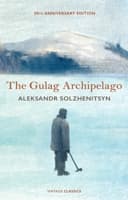
The Gulag Archipelago: The Authorized Abridgement
(Part of the The Gulag Archipelago 1918-1956 Series)
Conditions
A read copy that remains in clean condition.
Formats
Conditions
A read copy that remains in clean condition.
(Part of the The Gulag Archipelago 1918-1956 Series)
Conditions
A read copy that remains in clean condition.
Formats
Conditions
A read copy that remains in clean condition.
The official, one-volume edition, authorized by Solzhenitsyn
"BEST NONFICTION BOOK OF THE 20TH CENTURY" --Time
The Nobel Prize winner's towering masterpiece of world literature and a landmark of Russian history, the searing record of four decades of terror and oppression, in one abridged volume (authorized by the author). Features a new foreword by Anne Applebaum.
"It is impossible to name a book that had a greater effect on the political and moral consciousness of the late twentieth century." --David Remnick, The New Yorker
Drawing on his own experiences before, during and after his eleven years of incarceration and exile, on evidence provided by more than 200 fellow prisoners, and on Soviet archives, Solzhenitsyn reveals with torrential narrative and dramatic power the entire apparatus of Soviet repression, the state within the state that once ruled all-powerfully with its creation by Lenin in 1918. Through truly Shakespearean portraits of its victims-this man, that woman, that child-we encounter the secret police operations, the labor camps and prisons, the uprooting or extermination of whole populations, the "welcome" that awaited Russian soldiers who had been German prisoners of war. Yet we also witness astounding moral courage, the incorruptibility with which the occasional individual or a few scattered groups, all defenseless, endured brutality and degradation. And Solzhenitsyn's genius has transmuted this grisly indictment into a literary miracle.
"The greatest and most powerful single indictment of a political regime ever leveled in modern times." --George F. Kennan
"Solzhenitsyn's masterpiece. ... The Gulag Archipelago helped create the world we live in today." --Anne Applebaum, Pulitzer Prize-winning author of Gulag: A History, from the foreword
This essential historical document explores the depths of a totalitarian state:
The original works were published in a 3 volume series. Later, an abridged version was released that more or less condensed the 3 volumes into one. Be sure you're buying the correct "volume" you're interested in, 1, 2, or 3, or if you're interested in the abridged version, make sure it says that or something like "now in one book". Happy reading, hope this helps!
In the description its says 3 books. I received 1 book with V-VII part??? Where is 1-IV part?
It is hard to measure how profound a book like this is, because it covers such a wide range of subjects almost subtlely. The things that you are likely to remember are the descriptions of torture, the small amounts of food, and so forth. What you remember is the things that made you cringe, and realise that you probably would have given up had you been placed in the same situation. But as Solzhenitsyn tried repeatedly to bring out, it was the so-called "little" things that really either killed you, or gave you hope. As an example, many people might recall the sticking of hot metal up certain areas of the human anatomy; but as Solzehnitsyn said, this was most often not necessary. Seemingly mundane (relatively speaking) things like sleep deprivation was enough to drive even the most stable men insane. It was not the hot flash of pain that would get most people, but the exhaustion of wakefulness. Monotony could be every bit as much your enemy as freezing temperatures; and it was just as likely to send you to your death. These are but two examples, Solzehnitsyn gives up many more. If there is any book that can and should be read by everyone, it is this book. One need not be interested in communism, political theory, or such things for this book to have meaning. This book is above all about the human condition. It is a biograpy and autobiography about every man who has ever suffered greatly, and it is a lesson to every man who has never suffered greatly.
This book is a beutiful piece of literature and history. It was also written while on the run from the most devastating goverment in existence. The book is much more intresting to read, literature wise, than most academic works. The truth of the horrible soviet conditions in the gulag and the horrible and equally evil denial of the west that these things happened. This is a book that should be read in many places, at least in Russia, and for anyone else who truly wants to understand human life and the history of humanity.
"The line between good and evil runs through the heart of every human being." This abridged edition of Solzhenitsyn's hauntingly intimate portrait of his own arrest, interrogation, imprisonment, rebellion, and eventual release during Stalin's purges is a book like no other. This book, written by a constantly watched and persecuted dissident - bent but not broken by the brutality of Stalinist work camps, shares the author's (and his other inmates') personal experiences falling into this dark, usually fatal, abyss. Solzhenitsyn's original work was published in 1971 and produced an absolutely damning indictment of communism in Russia. Indeed, the stunning quality and importance of his writing earned him a Nobel prize. Besides his own experiences, Solzhenitsyn collected personal stories from hundreds of his fellow inmates. The sadism of interrogators, the cruelty of guards, the indifference of neighbors, the paranoia of the public, the betrayal of stoolies, and the true comradery of innocent inmates are presented in vivid, factual detail. In addition to this, the author also presents an encyclopeadic knowledge of the entirety of the gigantic Stalinist security apparatus (normal labor camps, special labor camps, transfer camps, railroad transfers, prisons, holding cells, interrogation cells, NKVD, SMERSH, commissars, exile communities, and still more). But at the heart of it all, the book remains an unforgettable journey through man-made hell. Stalin meant to destroy every man, woman, and child arrested, regardless of their innocence, and he largely succeeded. But survivors like Solzhenitsyn did truly 'tear down the wall' and made this world a far better place to live in. We all owe him a huge debt of gratitude!
How thin is the veil we call Civilization!! This book is indeed a tedious read by virtue of its length. However, Solzhenitsyn's history is written with the prosaic style of a Tolstoy or Dostoyevsky. Aleksandr Solzhenitsyn was a Captain in the Soviet Army as it charged through Nazi occupied Poland when he was arrested on trumped-up charges in February 1945. Thus began his odyssey through Gulag, "the country within a country". The perpetually weak economy of Communism could not survive without the forced labor of millions of is own citizens who became prisoners for one reason or another, or no reason at all. Solzhenitsyn relates his own experiences as well as those of other prisoners with whom he became acquainted while incarcerated. He relates how ordinary Russians were arrested and charged with fraudulent charges (if charged at all), interrogated, tortured and forced to confess under extreme duress, and sent off to labor for the good of the Motherland. Throughout the book, Solzhenitsyn asks the reader incredulously, "how did we let this happen?" That is no doubt one of the most important questions posed in all of human history. If we study history in order to prevent the repetition of our mistakes, then Solzhenitsyn's work should be required reading of all residents of Planet Earth.