


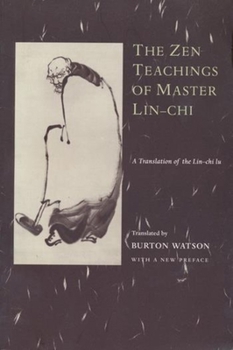
The Zen Teachings of Master Lin-CHI: A Translation of the Lin-CHI Lu

Select Format
Select Condition 
Book Overview
Among the most important texts of Zen literature, the Lin-Chi lu details the insights and exploits of the great ninth century Chinese Zen master Lin-chi, one of the most highly regarded of the T'ang period masters. PEN Translation Prize-winner Burton Watson presents here an eloquent translation -- the first in the English language -- of this seminal classic, The Zen Teachings of Master Lin-chi . The work is an exacting depiction of Lin-chi's words and actions, describing the Zen master's life and teaching, and includes a number of his sermons. Because Lin-chi's school outlasted other forms of early Chinese Zen to become dominant throughout China to this day, this translation bears unique significance within the literature of this great Asian nation. With Watson's lucid introduction to the work, a glossary of terms, and notes to the text, The Zen Teachings of Master Lin-chi is a generously constructed and accessible model of translation that will stand as the definitive primary material on Lin-chi for many years to come.
Format:Paperback
Language:English
ISBN:0231114850
ISBN13:9780231114851
Release Date:April 1999
Publisher:Columbia University Press
Length:180 Pages
Weight:0.54 lbs.
Dimensions:0.6" x 6.0" x 9.0"
Grade Range:Postsecondary and higher
Customer Reviews
4 ratings
Sometimes a Shout is Like a Golden-Haired Lion
Published by Thriftbooks.com User , 17 years ago
This is one of the earliest and greatest Zen classics devoted to the teaching of an individual Master, a genre invented within Zen. In earlier Buddhism what was taught was what the Buddha had taught, what the Sutras recorded. Zen emphasised the uniqueness of the moment and the need for newly improvised teachings, because of the way the mind forms a "skin" over what it has learnt. So Masters taught directly from their own realisation and not from the Sutras. Devoted disciples would then note down and record their words. But there's a paradox here - a permanent record of a unique moment - and some Masters disapproved and actively tried to destroy such records of their teachings. Lin-chi was a formidable character even by the standards of Zen Masters. He was famous for the ferocious, unnerving shout which he would unleash when least expected, in the same way other Masters used blows: to stop the busy minds of his followers for a moment. But all of his teachings ultimately had no other purpose: and he can be scary, crude, confrontational. He uses all means to teach one simple but elusive lesson: what is to be sought is what does the seeking: Mind itself, and not any limited image, concept or insight that Mind can come up with. Thus he also uses those double-edged words that have caused so much trouble and confusion ever since: "There is nothing to be done, nothing to achieve, nothing to be attained". At times, surprisingly, he could also come out with passages of mysterious poetic imagery, in which he codifies some of the basic thought-structures of Zen, which have been argued over and commented upon ever since. He also coined the phrase "the real person with no position". Burton Watson's translation aims at capturing the original's raw colloquial vigour, and as usual when academics do colloquial the results are sometimes awkward ("If you want to be a first rate fellow...") But this is a tiny flaw in a fluent translation of an essential and inexhaustible Zen classic.
An essential text for all Zen students and practitioners
Published by Thriftbooks.com User , 18 years ago
A wonderful translation of an essential text for all Zen students and practitioners. The Zen teachings of Lin-chi (Rinzai) pack the force of a nuclear blast. The record of Lin-chi foregoes any pretense to gradual guidance and delivers its Zen message in raw, heavy bucket-fulls. Burton Watson's translation of The Zen Teachings of Master Lin-Chi (Sung edition), like his other translations, is exceptional. Without sacrificing either the letter or the spirit, Mr. Watson makes the Record of the seminal Zen master Lin-chi (Rinzai) accessible to English readers with all the clarity and force of the original. With his usual high standard in regard to scholarship, Burton Watson provides extensive notes to each section. He also includes translations of the two alternate versions of two sections of the Lin-chi lu in Ming editions of the Ku-tsun-su yu-lu, and a decent glossary.
The master speaks
Published by Thriftbooks.com User , 25 years ago
This is probally one of the best Zen books I've ever read!!! Lin-chi (Rinzai) speaks in a clear manner easy to understand. Like a true master he knows how to get straight to the "heart" of Zen. It's no wonder a school of Zen is named after him.
This is a correction of your information
Published by Thriftbooks.com User , 27 years ago
The translator of this should be Burton Watson; it looks to be a new editions of the Shambala Dragon edition of 1994. check with publisher so you will provide your readers with accurate information
Copyright © 2026 Thriftbooks.com
Terms of Use | Privacy Policy | Do Not Sell/Share My Personal Information | Cookie Policy | Cookie Preferences | Accessibility Statement
ThriftBooks ® and the ThriftBooks ® logo are registered trademarks of Thrift Books Global, LLC
ThriftBooks ® and the ThriftBooks ® logo are registered trademarks of Thrift Books Global, LLC
