


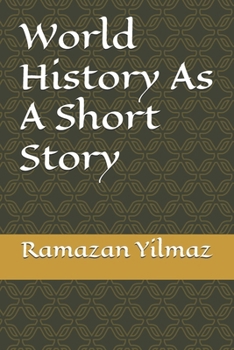
World History As A Short Story
No Customer Reviews

The work aims to narrate a world history by focusing not only on humankind -the primary subject of history- but also on the developments that have taken shape around it. Fundamentally, it is a 'once upon a time' story. A distinct narrative method has been employed, partly following a chronological order but occasionally deviating from this to shift the focus. The reason for this is twofold: firstly, to recount events without losing sight of their historical connections and context; and secondly, to present certain significant events that emerged later within the periods in which they held meaning for humanity, thereby offering a perspective that relates both to that specific era and to the level of awareness prevailing in the preceding period. Following the section on Prehistoric Times, there is a brief account of the Neolithic Age, followed by the section on the Ancient World from around 5000 BC onwards. In order: the Sumerian and Egyptian civilizations of the Ancient World and their significance, writing in history, the Minoan civilization, the first organized armies in history, mining, the Chinese and Indus civilizations, Canaan, Babylon, the Hittites, Phoenicia, the Mycenaeans and the Vedic Age, the ancient civilizations of the Americas, Africa and the Abyssinians, Carthage, Ancient Greece, the Hellenistic and Roman periods, Indian civilizations and Far Eastern beliefs, the Hunnic Turks, Far Eastern countries and Macedonia. Subsequently, under the main heading 'Anno Domini Zero Point', the text discusses Rome and Christianity, historical Turkic states, the Barbarian tribes and the Roman invasions, the Carolingian period and the Chinese dynasties. Following this, under the heading 'The Islamic Era and the Islamic Era', the text covers the Umayyads and Abbasids, the Turks, the spread and schism of Christianity in Europe, the Russians, the Crusades, Islamic civilization and science, and subsequently the Mongol invasions and the Ottomans. Moving towards the Modern Age, the course focuses in particular on Sultan Mehmet (The Conquer) transformative impact and his influence across the world, Andalusia and the Inquisition, the Far East and the New World. This is followed by an examination of the European Enlightenment, the Renaissance and the Reformation. Ocean voyages and overseas geographical expeditions, along with their global impact, as well as the spread of colonization, imperialism and slavery, are examined. This section details the decline of the Ottoman Empire and the transformations that followed the West's scientific Enlightenment. Following a discussion of the French Revolution, the founding of the United States and other significant developments, the course covers World Trade, Industrialization and the Industrial Revolution, the Pursuit of Innovation and Independence Movements, the world wars of the 20th century, the development, significance and impact of fossil fuels, global economic developments, freedom movements and, finally, the Cold War era and developments in the Space Age are discussed.
Format:Paperback
Language:English
ISBN:B0DVCHJLG3
ISBN13:9798308521273
Release Date:January 2025
Publisher:Independently published
Length:349 Pages
Weight:1.03 lbs.
Dimensions:9.0" x 0.8" x 6.0"
Customer Reviews
0 rating
Copyright © 2026 Thriftbooks.com
Terms of Use | Privacy Policy | Do Not Sell/Share My Personal Information | Cookie Policy | Cookie Preferences | Accessibility Statement
ThriftBooks ® and the ThriftBooks ® logo are registered trademarks of Thrift Books Global, LLC
ThriftBooks ® and the ThriftBooks ® logo are registered trademarks of Thrift Books Global, LLC
