


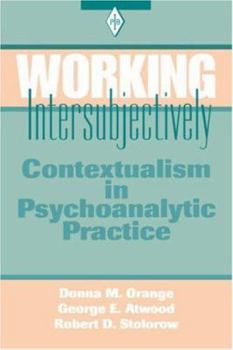
Working Intersubjectively: Contextualism in Psychoanalytic Practice

Select Format
Select Condition 
Book Overview
From an overview of the basic principles of intersubjectivity theory, Orange, Atwood, and Stolorow proceed to contextualist critiques of the concept of psychoanalytic technique and of the myth of analytic neutrality. They then examine the intersubjective contexts of extreme states of psychological disintegration, and conclude with an examination of what it means, philosophically and clinically, to think and work contextually.
This lucidly written and cogently argued work is the next step in the development of intersubjectivity theory. In particular, it is a clinically grounded continuation of Stolorow and Atwood's Contexts of Being (TAP, 1992), which reconceptualized four foundational pillars of psychoanalytic theory -- the unconscious, mind-body relations, trauma, and fantasy -- from an intersubjective perspective. Working Intersubjectively expounds and illustrates the contextualist sensibility that grows out of this reconceptualization. Like preceding volumes in the Psychoanalytic Inquiry Book Series by Robert Stolorow and his colleagues, it will be theoretically challenging and clinically useful to a wide readership of psychoanalysts and psychoanalytically informed psychotherapists.Format:Paperback
Language:English
ISBN:0881633607
ISBN13:9780881633603
Release Date:September 2001
Publisher:Routledge
Length:116 Pages
Weight:0.40 lbs.
Dimensions:0.3" x 6.1" x 9.0"
Customer Reviews
1 rating
intersubjective meditations
Published by Thriftbooks.com User , 26 years ago
Orange, Atwood, and Stolorow have put together a quite well-written and thoughtful meditation on intersubjectivity in psychoanalysis. They include a revolutionary chapter which philosophically reconceptualizes psychoanalysis as a form of "practice" or "ethical know-how" rather than a mechanical, programmatic "technique." There is also a very striking, detailed portrayal of the phenomenology of psychotic states, which the authors call "annihilation experiences" and interpret in terms of experiences of invalidation and usurpation by others. These authors situate their whole discussion within the theoretical framework of what they call "contextualism," a methodological sensibility which involves seeking the intelligibility of psychological phenomena by closely examining their interpersonal and historical contexts. The only drawback to this book is a rather turgid chapter on analytic neutrality, which, however, still has some interesting things to say. I'd strongly recommend this book to anyone interested in contemporary psychoanalysis, or the connection between philosophy and psychology. It would be especially good for anyone who may have had trouble with these theorists' previous work, as it is much more clearly written than their earlier books.
Copyright © 2026 Thriftbooks.com
Terms of Use | Privacy Policy | Do Not Sell/Share My Personal Information | Cookie Policy | Cookie Preferences | Accessibility Statement
ThriftBooks ® and the ThriftBooks ® logo are registered trademarks of Thrift Books Global, LLC
ThriftBooks ® and the ThriftBooks ® logo are registered trademarks of Thrift Books Global, LLC
