



Select Format
Select Condition 
Book Overview
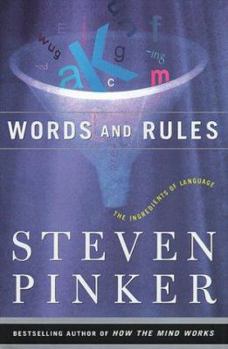
An "excellent work of popular science" (New Republic) by a New York Times-bestselling author that unites history and science to reveal how the mind does language In Words and Rules, Steven Pinker... This description may be from another edition of this product.
Format:Hardcover
Language:English
ISBN:0465072690
ISBN13:9780465072699
Release Date:October 1999
Publisher:Basic Books
Length:368 Pages
Weight:1.49 lbs.
Dimensions:1.3" x 6.5" x 9.6"
Customer Reviews
4 ratings
Mystery of mind revealed through language
Published by Thriftbooks.com User , 24 years ago
This is the first Pinker's book I've read; this may or may not be the best choice. In a flush of serendipity, I started finding references to Dr. Pinker and his works elsewhere; turns out he is considered one of the pivotal figures of modern evolutionary psychology and an archenemy of New Age, feminist and other postmodern, erm, thinkers. That alone could have driven me to his works; but I stumbled upon this book by pure chance, and I am very glad I did."Words and rules", as its title suggests, is a less ambitious and more technical book than "The Language Instinct" or "How the Mind Works". It is likely to produce less controversy. It is less than friendly for readers without background in linguistics. There are very few far-reaching conjectures - most of the stories Pinker recounts are solid, scientifically verified data.However, the consequences which follow are disturbing and unusual. The seemingly trivial question of regular and irregular words in languages, and English irregular verbs in particular, has major repercussions for this other question Dr. Pinker had tackled earlier - how the mind works.To try to sum it up: in language acquisition and language use, humans employ two systems: memory and structure, lexicon and grammar, words and rules. They are interdependent, but distinctly separate. Their separation in human minds is illustrated by numerous examples from children's speech mistakes, speech impediments in people with various brain injuries, and neurological data, obtained by more or less direct observation of brain activity. All languages depend heavily on words; you cannot use even Esperanto unless you have mastered its basic vocabulary. As for rules, their participation in speech differs from language to language, but there is no language which does not use rules at all. People resort to rules whenever there is a failure of access to memory. For example, if you encounter a nonsense verb - "to squink" - you are much more likely to form its past tense as "squinked", not "squank", because you do not have any "squank" in your memory bank, and the regular "-ed" suffix jumps into play immediately. Pinker convincingly shows in one of the most amazing chapters of his book, that regularity does not necessarily mean statistical prevalence; true, there are many more regular verbs in English than irregulars; but in German, for example, the default plural of nouns is formed by the *least* frequent suffix, which just happens to be regular and therefore resides in the "rules" domain rather than in "words".No specific language is innate; no serious scholar would dispute it. Whether there are any linguistic universalia, is, as far as I understand, still debatable. Pinker's approach is, however, one step higher; it deals with the language instinct, with the innate ability to implement communication through language - and the tools which organize it into a system. It is probably more complex than the dualism of words and rules; but as a first approx
Language is Fun? Language is Fun!
Published by Thriftbooks.com User , 26 years ago
Whoever would think that an entire book could be written on the subject of verbs: regular and irregular. But Pinker does a dynamic job of making language sing. He recognizes the liquidity of language, its morphing and morphosis of rules, and its complete fascination. This is the third Pinker book I have read - and can't wait for the next one. I jumped into this one expecting repetition from his other books, but he continues to surprise us with completely new slants about language, completely new examples. Only his expertise and broad sense of humor remain familiar. I have to read slowly so I can absorb all the nuances suggested. Still, I hate to lay the book down. Major entertainment and fascinating information.
Perfect for us word nerds
Published by Thriftbooks.com User , 26 years ago
The thing about Steven Pinker is that he can take an esoteric subject like How the Mind Works, or 'Words and Rules', and through his wit and choice of examples, make the subject not only come alive, but charm us as well. Who would have thought that a book about irregular English verbs would be so much fun to read?
Word and Rules
Published by Thriftbooks.com User , 26 years ago
For winter break I wanted something fun to read...I intended to get Harry Potter books but got this by chance off the new books table. I have a degree in linguistics but haven't kept up with what is happening in the area. I have throughly enjoyed reading this book. The author provided plenty of background information and wonderful illustrations (and cartoons too!) to explain the points of the text. I haven't finished the book but it is going fast. I highly recommend it for teachers of literacy and language. There are terrific ways to explain the irregular, and for that matter regular, verbs in English. The glossary is a great, quick guide to terms in the field as well as terms in the text. This my first book by this author and I plan to read others.
Copyright © 2026 Thriftbooks.com
Terms of Use | Privacy Policy | Do Not Sell/Share My Personal Information | Cookie Notice | Cookie Preferences | Accessibility Statement
ThriftBooks ® and the ThriftBooks ® logo are registered trademarks of Thrift Books Global, LLC
ThriftBooks ® and the ThriftBooks ® logo are registered trademarks of Thrift Books Global, LLC
