


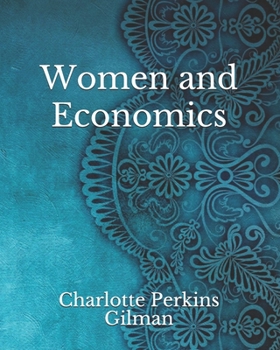
Women and Economics
No Customer Reviews

It is commonly assumed that this condition also obtains among other animals, but such is not the case. There are many birds among which, during the nesting season, the male helps the female feed the young, and partially feeds her; and, with certain of the higher carnivora, the male helps the female feed the young, and partially feeds her. In no case does she depend on him absolutely, even during this season, save in that of the hornbill, where the female, sitting on her nest in a hollow tree, is walled in with clay by the male, so that only her beak projects; and then he feeds her while the eggs are developing. But even the female hornbill does not expect to be fed at any other time. The female bee and ant are economically dependent, but not on the male. The workers are females, too, specialized to economic functions solely. And with the carnivora, if the young are to lose one parent, it might far better be the father: the mother is quite competent to take care of them herself. With many species, as in the case of the common cat, she not only feeds herself and her young, but has to defend the young against the male as well. In no case is the female throughout her life supported by the male.In the human species the condition is permanent and general, though there are exceptions, and though the present century is witnessing the beginnings of a great change in this respect. We have not been accustomed to face this fact beyond our loose generalization that it was "natural," and that other animals did so, too.To many this view will not seem clear at first; and the case of working peasant women or females of savage tribes, and the general household industry of women, will be instanced against it. Some careful and honest discrimination is needed to make plain to ourselves the essential facts of the relation, even in these cases. The horse, in his free natural condition, is economically independent. He gets his living by his own exertions, irrespective of any other creature. The horse, in his present condition of slavery, is economically dependent. He gets his living at the hands of his master; and his exertions, though strenuous, bear no direct relation to his living. In fact, the horses who are the best fed and cared for and the horses who are the hardest worked are quite different animals. The horse works, it is true; but what he gets to eat depends on the power and will of his master. His living comes through another. He is economically dependent. So with the hard-worked savage or peasant women. Their labor is the property of another: they work under another will; and what they receive depends not on their labor, but on the power and will of another. They are economically dependent. This is true of the human female both individually and collectively.
Format:Paperback
Language:English
ISBN:B092LWP18F
ISBN13:9798736827503
Release Date:January 1
Publisher:Independently Published
Length:152 Pages
Weight:0.69 lbs.
Dimensions:0.3" x 8.0" x 10.0"
Customer Reviews
0 rating
Copyright © 2026 Thriftbooks.com
Terms of Use | Privacy Policy | Do Not Sell/Share My Personal Information | Cookie Policy | Cookie Preferences | Accessibility Statement
ThriftBooks ® and the ThriftBooks ® logo are registered trademarks of Thrift Books Global, LLC
ThriftBooks ® and the ThriftBooks ® logo are registered trademarks of Thrift Books Global, LLC
