


Value Investing


Select Format
Select Condition 
Book Overview
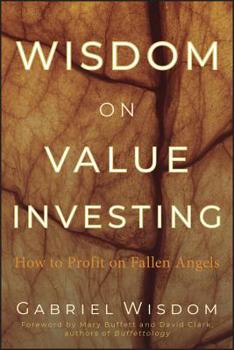
Wisdom on Value Investing offers author Gabriel Wisdom's insights on succeeding in difficult markets. One of his favorite approaches-which is part classic value investing and part behavioral finance-is called "The Fallen Angels Investment Strategy," and it prepares investors to look past short-term value assumptions in order to capture profits. Throughout this book, Wisdom will show you how to capitalize on value plays where the fundamentals are actually strong, but the "general wisdom" surrounding the security has turned negative. He discusses how stocks with the most promise are ones that Wall Street has marked down without regard to their underlying value, and reveals how this type of intrinsic value discount provides a margin of safety during difficult times, and substantial upside rewards for those who find them early enough. Takes value investing one step further by mixing significant amounts of behavioral finance into the analysis Prepares investors to take advantage of other's mistakes A time-tested strategy for any type of market-up or down
A classic look at value investing with a twist, this book will put you in a better position to succeed in both bull and bear markets.
Includes a Foreword by Mary Buffett and David Clark, authors of Buffettology.
Format:Hardcover
Language:English
ISBN:0470457309
ISBN13:9780470457306
Release Date:October 2009
Publisher:Wiley
Length:208 Pages
Weight:0.65 lbs.
Dimensions:0.8" x 6.3" x 9.3"
Customer Reviews
4 ratings
A Practitioner's Primer on Value Investing
Published by Thriftbooks.com User , 16 years ago
There is a pun in the title of the new book, Wisdom on Value Investing (John Wiley, 2009). The author is Gabriel Wisdom, and what he sets out is wisdom concerning the "value investing" style. Wisdom is a co-founder of American Money Management, LLC and President of the Fallen Angel family of mutual funds. According to the book jacket, he has managed "more than a billion dollars for wealthy investors since 1983." He hosts a daily program on Business Talk Radio Network. The author favors "fallen angels"--securities offered at prices below their intrinsic value. There are three sources of such situations, he says: the business cycle, excessive pessimism in the market and a one-time "calamity befalling an otherwise sound company" (pp. 18-20). He urges the reader to follow a contrary stance, against prevailing sentiment in the market. Wisdom suggests as standards of value a number of financial statistics followed by most value investors, including the price to earnings ratio, debt level, return on equity and free cash flow. One question that many investors puzzle over is when to sell. Wisdom cites three signals: first, if the reason you bought is no longer valid; second, if profits come sooner than expected (in other words, don't succumb to over-optimism); third, if a better opportunity comes along. In practice, those who have an eye for something worth holding a long time are probably best suited for the value style of investing. I'm not sure if Warren Buffett has ever unloaded a company, although a few of his picks (especially early on, such as Dexter Shoe) came out poorly. At times, the reader may be puzzled by Wisdom's practice of citing investment principles that are in tension with one another, without his resolving or even noting such differences. For example, he cites Shawn Andrew to the effect that the crowd is usually right, except at major turning points (p. 9) but also cites with approval George Soros' statement: "I assume that the markets are always wrong" (p. 131). By the same token, he cites Warren Buffet (p. 1) about how a net saver should buy when prices are sinking, but then he also recommends buying when technical patterns show a rising price trend, albeit close to the bottom. Although most of this book concerns securities investing, chapter fourteen concern real estate as the "other fallen angel opportunity." He sees evidence for an eighteen year real estate cycle in the United States, following the work of statistician Edward Dewey (1895-1978). The chapter discusses how to watch this recurrent pattern and invest opportunistically. He suggests as examples of fallen angels in this area abandoned properties in working class neighborhoods at the bottom of a business cycle. Wisdom offers a breakdown (pp. 114-117) of the "twelve most common opportunities for investors": fallen angels; out-of-favor blue chip stocks; spinoffs; overlooked smaller companies; companies run by gifted deal-makers; cyclical companies at the bottom of a c
Successful investing isn't rocket science; it's harder!
Published by Thriftbooks.com User , 16 years ago
Wisdom is right on the money with his new book. Isn't it true that when everyone else experiences fear, it is the best time to swoop in for the greatest opportunity? Of course it is all about knowing how to seize the opportunity and profit from it. You'll learn that here, how to find the stocks that are down but have a high probability to rise. I also like how Wisdom is not afraid of having an exit strategy, which most financial advisors don't generally understand the importance of. When you've got markets plummeting at 1,000 points a clip, wouldn't it make sense to exit your long positions before the crash? Yes, it does, and Wisdom shows you how. Bottom line is if you want to profit from value investing this book will get you on the right track. PS: Michael Moore, portfolio manager, has a great quote in the book "...Successful investing isn't rocket science; it's harder..." that sums it up nicely.
Focus On Your Investments More Closely With Wisdom's Book
Published by Thriftbooks.com User , 16 years ago
Gabriel Wisdom has a financial radio show that plays in my area every day at 4:00 pm and when I'm in the car driving around town its fun to listen in. He's always had great guests on his show from value and fundamental investors to technical analysis traders and everything in between. His knack for summing up the material in an easy to comprehend way is refreshing. What I like about his book, Wisdom on Value Investing, is how in Chapter 10 he shows exactly how to pick what he refers to as "Fallen Angels". These are high quality stocks that have fallen in price, and as Wisdom says, "...the best time to buy stocks - or anything else - is when no one else wants them...". My approach has generally been to use charts and technical analysis. This book is getting me started on blending in more fundamental concepts into the mix like evaluating revenue growth, earnings growth, and return on equity and debt to equity ratios. It will enable me to filter some of my investments and trades with a new perspective. These days we all have to focus on our investments more closely to prevent damage to our portfolios. This book is recommended for doing just that.
The Value of Breaking Out of the Herd
Published by Thriftbooks.com User , 17 years ago
Finally! A book on investing that's written in plain English and does not try to predict the future. From start to finish the author encourages the reader to utilize solid systems, creative original thought, and never again rely on a "me too" mentality. This book will accurately expand your view on your investing. The book provides valuable information to give you the confidence and systems to make sound and sensible decisions when choosing investments, never again having to rely on the alleged experts to lead you down the wrong path or over the cliff. Never make another investment decision based on fear. Anyone serious about investing, from the complete novice to the seasoned veteran, will benefit from reading this book. And for those who are not fearful of breaking out of the herd ... it's a real keeper!
Copyright © 2026 Thriftbooks.com
Terms of Use | Privacy Policy | Do Not Sell/Share My Personal Information | Cookie Notice | Cookie Preferences | Accessibility Statement
ThriftBooks ® and the ThriftBooks ® logo are registered trademarks of Thrift Books Global, LLC
ThriftBooks ® and the ThriftBooks ® logo are registered trademarks of Thrift Books Global, LLC
