


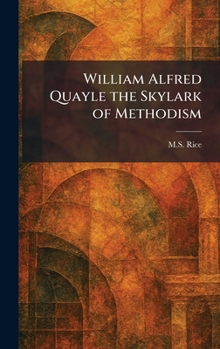
William Alfred Quayle the Skylark of Methodism

"William Alfred Quayle the Skylark of Methodism" is an insightful biography of one of the most vibrant and poetic figures in American religious history. Written by M.S. Rice, the work chronicles the life, ministry, and profound influence of Bishop William Alfred Quayle, a man celebrated for his exceptional oratory skills and his deep, spiritual appreciation for the natural world. Known widely as the "Skylark of Methodism," Quayle's legacy as a preacher and author is explored through his unique ability to connect the divine with the beauty of everyday life.
The narrative follows Quayle from his early years through his rise to leadership within the Methodist Episcopal Church, highlighting his intellectual contributions and his pastoral heart. Rice captures the essence of Quayle's personality-his wit, his literary breadth, and his infectious enthusiasm for the Gospel. This biography serves as both a historical record of a transformative era in Methodism and a testament to a leader who sought to inspire his congregants through the harmony of faith and nature. It remains an essential read for those interested in Methodist heritage, the history of the American pulpit, and the life of a truly remarkable spiritual leader.
This work has been selected by scholars as being culturally important, and is part of the knowledge base of civilization as we know it. This work was reproduced from the original artifact, and remains as true to the original work as possible. Therefore, you may see the original copyright references, library stamps (as most of these works have been housed in our most important libraries around the world), and other notations in the work.
This work is in the public domain in the United States of America, and possibly other nations. Within the United States, you may freely copy and distribute this work, as no entity (individual or corporate) has a copyright on the body of the work.
As a reproduction of a historical artifact, this work may contain missing or blurred pages, poor pictures, errant marks, etc. Scholars believe, and we concur, that this work is important enough to be preserved, reproduced, and made generally available to the public. We appreciate your support of the preservation process, and thank you for being an important part of keeping this knowledge alive and relevant.
Customer Reviews
ThriftBooks ® and the ThriftBooks ® logo are registered trademarks of Thrift Books Global, LLC
