


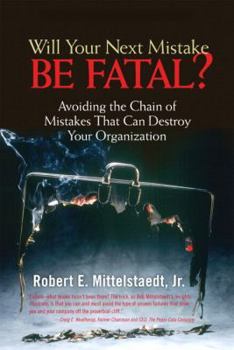
Will Your Next Mistake Be Fatal?: Avoiding A Chain Of Mistakes That Can Destroy Your Organization

Select Format
Select Condition 
Book Overview
Focuses on what catastrophes have in common - and how to keep them from happening to you. This title introduces M3: the first systematic approach to - managing mistakes, so they don't lead to... This description may be from another edition of this product.
Format:Hardcover
Language:English
ISBN:0131913646
ISBN13:9780131913646
Release Date:January 2004
Publisher:Pearson P T R
Length:309 Pages
Weight:1.38 lbs.
Dimensions:9.0" x 1.0" x 6.0"
Customer Reviews
5 ratings
My best "computer" book of the year
Published by Thriftbooks.com User , 20 years ago
I think so highly of this book that I listed it as the best book of the year in my annual "Best Books of the Year" column that I write for the online "Journal of Object Technology" (JOT). JOT is a journal written for people who use object-oriented technologies to teach computer science and develop large software projects. The process of creating a program that has millions of lines of source code is a very complex one, there are millions of ways you can fail and only a few ways that you can succeed. The main point is that catastrophic mistakes are generally not due to one big error, but are the consequence of a series of small errors that reinforce each other. Major historical failures such as the sinking of the Titanic, the meltdown at Three Mile Island, plane crashes, business failures such as the collapse of Enron and the associated destruction of Arthur Anderson are all examined in detail. The failures can generally be placed in one of the following categories: *) Failure to question an authority figure. *) Not trusting hard data. *) Trusting "hard" data too much. *) Believing only the data that agrees with your beliefs. *) Tolerating violations of proven procedure. *) Lack of adequate training and experience. *) Arrogance or a feeling of infallibility. It amazed me to read how in most cases, the correction of even one of the small mistakes in the chain could have led to a minimization or avoidance of the catastrophe. There are also examples of successful recoveries from catastrophic events. In 1982, several people died due to a tampering with the product Tylenol after it left the factories. The manufacturer, Johnson & Johnson, immediately engaged in a total recall and then reintroduced the product in a tamper-proof package. This reassured the public and while they took an immediate loss, the company recovered very quickly, maintained and increased their level of public trust. At some point, nearly every company is faced with a crisis that can make or break it. Given that there are generally so many small errors in the chain, in most cases many people can act to prevent a failure. By reading this book, you can increase your chances of being on the make side of the ledger.
It is about discipline, culture, and learning from the experiences of others
Published by Thriftbooks.com User , 20 years ago
"This is not a book about crisis management. It is not about managing public relations, the victims, the lawyers, or the shareholders. It is about discipline, culture, and learning from the experiences of others to improve the odds that you can avoid the things we label as accidents, disaster, or crisis altogether. Even if you do not totally avoid such situations, knowledge of the typical patterns that occur should help you create an organization that is observant enough to intervene early and minimize damage. Learning and implementing the lessons described here will not mean that you throw away your plans for handling problem situations. But it could mean that you will never have to manage the aftermath of an unpleasant situation (from the Introduction)." In this context, Robert E. Mittelstaedt, Jr. divides this excellent handbook into ten chapters and an Appendix as summary of insights. For this Appendix, R. E. Mittelstaedt, Jr. says that "Summarized here are the insights associated with the accidents, incidents, and successes examined in the book. They are offered with the caution that slavishly adhering to them in the hope of avoiding all mistakes will not necessarily lead to success, because success is different than a lack of failure, which might lead to mediocrity. Despite the caution that success requires more than avoiding mistakes, these are powerful insights into the ways that many have ‘snatched defeat from the jaws of victory.’ The patterns are similar and have shown themselves repeatedly over and over again in a variety of industries, countries, and businesses. Additionally, if we are honest we can see similarities to the things that drive or hinder our personal success in school, careers, sports, and social relationships. Consider these guidelines for most situations, personal or business, and look not only for their occurrence individually, but in patterns that serve as warnings for analysis and action (p.289)." Summary of Robert E. Mittelstaedt’s Summary of Insights: • Insight #1: Mental preparation is critical because organizations and individuals are rarely good at learning by drawing parallels. • Insight #2: Fly the airplane. • Insight #3: You cannot afford even a whiff of an ethical lapse. • Insight #4: Execution mistakes can be generated through a lack of resources or knowledge. • Insight #5: Establish and enforce standard operating procedures. • Insight #6: Make responsibilities clear. • Insight #7: Seek advice and seek to understand assumptions. • Insight #8: If something does not make sense or feels confused, STOP and figure out what’s going on. • Insight #9: People are usually at the root of the problem. • Insight #10: A significant portion of execution-related mistakes occur because criteria for measuring progress and performance have not been identified and/or communicated explicitly. • Insight #11: Failure to analyze data points and ask what they mean is a major source of mistakes. • Insight #12: Igno
Packed with Knowledge!
Published by Thriftbooks.com User , 20 years ago
Robert Mittelstaedt has written a rare, commendable book. He manages to address a significant business topic - the phenomenon of major corporate blunders - in an original, insightful and entertaining way. In this intriguing volume, he cites case after fascinating case where a series of seemingly small errors went uncorrected until a whole house of cards marked "faulty assumptions" came crashing down. The biggest mistake you can make is assuming that a fatal blunder just couldn't happen in your organization, and the second biggest is ignoring the warning signs that disaster is just ahead. The key, Mittelstaedt advises, is to learn to admit that something has gone wrong before the situation spirals out of control. We encourage every thoughtful business professional to read this substantive contribution to the field of risk management and disaster prevention.
A Fatal Attraction
Published by Thriftbooks.com User , 20 years ago
The one comforting realization this author brings out in his book is that significant or catastrophic events are usually caused by a long trail of mistakes. Thus, unlike say a car crash that can be caused by one simple mistake, the business version of a car crash is preventable if you can identify the mistakes. The author calls this the process of managing multiple mistakes. If you can find a away to break a chain of mistakes, a major issue can be avoided. This book attempts to educate the reader about the avoidable traps that business people tend to set for themselves. The author details many of the higher profile blunders over the past 30 years to show the reader the patterns and to act as case studies. It attempts to help the reader learn from the experiences of others to improve the odds that the reader can also avoid disasters. The author believes that there are lessons to be learned from looking at the mistake patterns and common themes that have taken place in other organizations. The author believes that most organizations and people for that matter, lack the drive to truly investigate and examine the mistakes they make individually and in business, thus learning opportunities are lost. The author believes then that by looking at others mistakes, it can at least for us, lead to learning. Overall I found the book to be informative and interesting. It was sort of like watching a series of train wrecks in slow motion. It also provides an interesting way to view behavior to help the reader in identifying the chain of mistakes before you become one of the footnotes of history. The book is well worth your time.
Excellent material and so relevant for today's businesses...
Published by Thriftbooks.com User , 21 years ago
As I was part of one of the biggest corporate mistakes in U.S. history, I thought it would be interesting to read Will Your Next Mistake Be Fatal? by Robert E. Mittelstaedt, Jr. I wasn't disappointed... This should be required reading in all organizations. Chapter list: The Power of M3 and the Need to Understand Mistakes; Execution Mistakes; Execution Mistakes and Successes as Catalysts for Change; Strategy - How Do You Know It's a Mistake?; Physical Disasters with Cultural Foundations and Business Implications; Cultures that Create "Accidents"; Mistakes as Catalysts for Cultural Change; Economics at Work: Watching Entire Industries Lose It; Mistakes Aren't Just for Big Companies - Small Company Chains; Making M3 Part of Your Culture for Success; Summary of Insights; References; Index I started working for Enron Broadband back in 1998 when it first got going. I was laid off on September 1st, 2001 when the Portland office closed. Little did any of us know that the entire company would melt down just three months later. Did they plan for that to be the culmination of all their actions? No, but no one in power saw the signs and had enough courage to stop the string of mistakes that ultimately doomed the company. Mittelstaedt uses Enron and numerous other companies to show how a culture of tolerating mistakes can lead a company to the brink of disaster (and many times right over the edge). But instead of just concentrating on "when bad things happen to good companies", he also covers how strong leadership can allow a company to survive and prosper in adverse conditions (like J & J's handling of the Tylenol tampering case). There's a lot of material here that is excellent reading and should cause organizations to ponder their ways. There are 38 "insights" that summarize the main teachings and help the reader to focus on making the necessary changes for success. Insights such as "fly the airplane" and "you cannot afford even a whiff of an ethical lapse" are easy to remember and should quickly bring you back to a proper attitude for running a successful and thriving organization. Oh, and the "M3" you see in the chapter list refers to "managing multiple mistakes". Once you start to implement a systematic approach to M3, you won't guarantee that your company will never make an error or misstep again. But you will be assured of not letting things get totally beyond control. Excellent book, and it's so very relevant to today's business environment. A highly recommended read...
Copyright © 2025 Thriftbooks.com
Terms of Use | Privacy Policy | Do Not Sell/Share My Personal Information | Cookie Policy | Cookie Preferences | Accessibility Statement
ThriftBooks ® and the ThriftBooks ® logo are registered trademarks of Thrift Books Global, LLC
ThriftBooks ® and the ThriftBooks ® logo are registered trademarks of Thrift Books Global, LLC
