


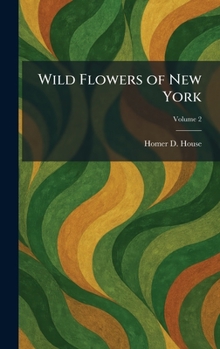
Wild Flowers of New York

"Wild Flowers of New York" stands as a monumental achievement in botanical documentation, meticulously chronicling the diverse and vibrant plant life of the Empire State. Written by renowned botanist Homer D. House, this second volume continues the exhaustive survey of indigenous floral species, offering detailed observations and scientific insights into the region's natural heritage.
The work serves as both a scientific reference and a tribute to the aesthetic beauty of North American flora. It provides readers with an in-depth exploration of various plant families, including their habitats, flowering periods, and distinguishing physical characteristics. As a cornerstone of early 20th-century natural history, the book remains an invaluable resource for botanists, conservationists, and nature enthusiasts seeking to understand the historical distribution and variety of wildflowers in the northeastern United States.
With its focus on accuracy and comprehensive classification, "Wild Flowers of New York" captures the essence of the state's wilderness before the modern era of significant urban expansion. This volume is an essential guide for anyone interested in the intersection of science and the natural world.
This work has been selected by scholars as being culturally important, and is part of the knowledge base of civilization as we know it. This work was reproduced from the original artifact, and remains as true to the original work as possible. Therefore, you may see the original copyright references, library stamps (as most of these works have been housed in our most important libraries around the world), and other notations in the work.
This work is in the public domain in the United States of America, and possibly other nations. Within the United States, you may freely copy and distribute this work, as no entity (individual or corporate) has a copyright on the body of the work.
As a reproduction of a historical artifact, this work may contain missing or blurred pages, poor pictures, errant marks, etc. Scholars believe, and we concur, that this work is important enough to be preserved, reproduced, and made generally available to the public. We appreciate your support of the preservation process, and thank you for being an important part of keeping this knowledge alive and relevant.
Customer Reviews
ThriftBooks ® and the ThriftBooks ® logo are registered trademarks of Thrift Books Global, LLC
