


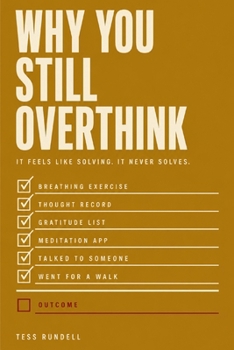
Why You Still Overthink: It Feels Like Solving. It Never Solves. The Real Reason Advice About Rumination and Worry Keeps Failing - and What Changes It

Breathe. Notice the thought without judgement. Ask whether it is helpful. Write it down. Challenge the distortion. Be present.
You know all of it. You may well have paid for some of it. And here you are, at whatever time it is, reading another book about it.
That is not a failure of effort. It is the most important piece of information in this book.
If you have genuinely tried nine techniques and still do the thing, you do not need a tenth technique.You need to know why the first nine were aimed at the wrong target.
Here is the argument, and it takes thirty seconds. Overthinking does not survive because you lack tools. It survives because it does not feel like a problem while it is happening. It feels like working. Like preparation, like fairness, like due diligence, like taking something seriously. And nobody voluntarily abandons an activity that feels productive, however many books instruct them to.
Almost all advice works on the content of your thoughts. Content is infinite.Answer one worry convincingly and your mind produces a variant within ninety seconds. The queue was never going to clear. What does not change is the process - and underneath the process sits a small set of beliefs, not about your life, but about thinking itself.
That thinking it through will make you readier. That you could not stop if you tried. That not worrying would mean you did not care. That there is an answer in there and you have not found it yet.
Those beliefs are the target. They are few, they are specific, and they are testable.
What is in itThirty-one short chapters across five parts - why it feels like solving, what it has actually cost you, the beliefs underneath, and what changes them
Four experiments you run on yourself, each about a fortnight, each producing a number - because a case does not move a belief you have held for twenty years, and your own data does
Three of those experiments worked through in full, with the real entries and what they showed - including the prediction that came true
A fourteen-day test, a belief card to carry, and a twenty-statement check to take now and again in six weeks
Chapters on the parts nobody covers - three in the morning, work, what other people think of you, and the things that are genuinely serious Built on real technique, and honest about its limits
Worry postponement, cognitive defusion, decatastrophising, stimulus control, and the metacognitive finding that the target is beliefs about thinking rather than thoughts themselves. There is also a section on what did not work - thought records, meditation apps, gratitude lists - because a book that reports only successes is not reporting.
One promise, and only one. This will not empty your head. Nothing does, and being told otherwise is part of why you gave up last time. What it will do is stop you being conscripted into every session your mind decides to schedule.
A practical self-help guide. It is not therapy and it is not a substitute for support from a qualified professional.
Customer Reviews
ThriftBooks ® and the ThriftBooks ® logo are registered trademarks of Thrift Books Global, LLC
