


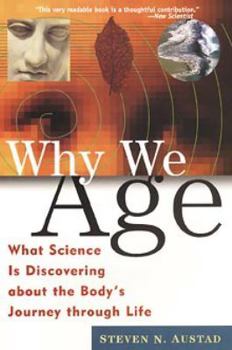
Why We Age P


Select Format
Select Condition 
Book Overview
Why has the life span of the average American increased from 48 to 75 years in this century alone? . . . If the body is a machine that simply wears out, why do some cells seem immortal? . . . Is there an aging gene? And can we control it? . . . Can antioxidants and hormone therapy actually slow the aging process and extend life? Steven Austad s compelling book investigates the history, the theories, and the personalities behind the quest to understand the nature of aging. Here is hard evidence from the front lines of research that science is finally closing in on the fundamental processes of human biology and life. "Austad s book can be read with pleasure and profit by any intelligent person with a smattering of biological knowledge." Science "In this clear, engrossing overview, Austad takes the sting out of a subject that will ultimately capture us all." Publishers Weekly "Why We Age is remarkably rigorous in its analysis and thorough scope. . . . A comprehensive examination of its topic." Science Editors, Amazon.com "The problem with long life is that one keeps getting older; here s an able and clearly written summary of the latest theories on why we age and what might be done to ameliorate the process." Kirkus Reviews
Format:Paperback
Language:English
ISBN:0471296465
ISBN13:9780471296461
Release Date:March 1999
Publisher:John Wiley & Sons
Length:260 Pages
Weight:0.86 lbs.
Dimensions:9.3" x 0.6" x 6.1"
Customer Reviews
5 ratings
An entertaining introduction to the science of aging
Published by Thriftbooks.com User , 24 years ago
Why do we age? The simple answer is, there is no simple answer. The simplest "simple" answer is probably, we age because we live, and living wears our bodies out.In order to live we breathe because our bodies use oxygen to convert food into energy. But in the process something called "oxidative damage" happens to our cells. In other words: we rust. Inevitably. The two other main reasons why bodies wear out are connected to glucose and "browning damage", and to self-repair mechanisms of our cells that fail to stop and lead to uncontrolled cell growth - what we call "cancer".The three processes of rusting, browning and cancer are part of aging. They are "how" we age. But "why" do we age at all? Why don't we stay healthy for, say, 150 years and then simply drop dead? In very simple terms the reason is: aging is genetic. The genes do not care about the body after the body has served its purpose: to replicate the genes and ensure that they can replicate again. This is called the "selfish gene" theory, an expression coined by Richard Dawkins.Gerontology, the study of aging, is a field of science in rapid growth. I do not claim to be a specialist; therefore I do not want to go into much detail here. Steven Austad's book explains very well "what science is discovering about the body's journey through life". He ends his book with a chapter of particular interest for women ("Reproductive Aging, Menopause, and Health"), and a chapter on our hopes of how to make the best of our ultimate genetic fate ("Slowing Aging and Extending Life: Remedies and Expectations").Apart from Austad's humor - it can be both droll and dry - I have particularly enjoyed his short portraits of scientists in the field of gerontology and evolutionary biology, such as the geneticist J.B.S. Haldane, the immunologist Peter Medawar, the American scientist Raymond Pearl (who in 1938 produced the first paper analyzing the extent to which smoking reduced life expectancy, but also was of the opinion that people above 50 should forfeit their right to vote, because they would have grown too foolish), the German physiologist Max Rubner, the gerontologist Alex Comfort (who discovered the joy - and profitability - of sex), the biologist John Maynard Smith, and the two-time Nobel prize winner Linus Pauling. Austad's cameo of Max Rubner is my favorite because of its psychological insight into the downside of dedication and narrow focus: "The first scientist to investigate the rate-of-living idea in any rigorous fashion was the German physiologist Max Rubner. Rubner could make people very uncomfortable with his Teutonic bluntness. He was noted for his long silences, punctuated with outbursts of aggressively sarcastic humor. But he was also an obsessively precise investigator of the energy contained in food and the use of that energy by animals. Like obsessives everywhere, he felt that the significance of his obsession was underappreciated by others."
This is the most amazing break through in science
Published by Thriftbooks.com User , 24 years ago
Wow, I am impressed. I never expected this to be a good book when I saw it on my collage reading list. This turned out not only to be scientific jargon, but keeps the reader facinated with the authors great personality which comes through in the writing.IF YOU BUY ONE BOOK EVER BUY THIS BOOK, AND IF YOU BUY ANOTHER, BUY THIS ONE AGAIN!
Gives a persuasive answer to a difficult question
Published by Thriftbooks.com User , 25 years ago
This interesting book is not about how to avoid ageing or about how to grow old gracefully, etc. Instead Austad is concerned quite simply, as his title says, in why we age.The argument that he develops from evolutionary biology is very subtle, but persuasive and profound. It's not that the ageing of individuals is good for the species. That's a fallacy, although it works that way. And it is not because of limited cell division. That too is an effect. Rather it is because evolution does not support system maintenance past the age of reproduction. In other words (this is a slippery, but nonetheless cogent and persuasive argument) no gene that either maintains the system or tears down the system or even just leaves the system as it is past reproductive age is selected. None are selected. All post-reproductive age mechanisms are instead randomly selected; that is, selected by accident. Since there is the second law of thermodynamics, or entropy, a random system will just run down. It will go to chaos; and for our bodies, that means breakdown. Simple as that.Still, the question remains, why don't we continue to reproduce as we grow older? Or, why isn't our reproductive age unlimited? The answer is subtle: such a system wouldn't work because it would be static and couldn't change with the environment. The old reproducers would, through the strength of their experience and position, control reproduction and naturally work against change. Consequently, they would drift away from their changing environment and become less fit. Also, the faster an environment changes the faster the species must adjust; therefore, reproduction at an earlier and earlier age would be selected for, consistent with the ability to gain subsistence. As is noted here and elsewhere, it is a melancholy fact that we age and die because of sexuality. Sexual reproduction only works if the young have a better chance at reproducing than the old. It should be realized that someone a generation younger is, paradoxically, a generation older in terms of genetic experience. The gene pool has mixed one more time. The young can only have the advantage if the experienced and powerful get old, weak and die. And so we do.
Amazing Answers to the Right Questions in Senescence
Published by Thriftbooks.com User , 26 years ago
If you are interested in health and the body, and have a scientific background, I think that you will find this book amazing. This is NOT a metaphysical questioning of death or a magic list of life lengthening behaviors. It is an attempt to understand why we age. As Steven points out, we use the word "why" to mean "how" many times. While he admits that it is not uninteresting or useless to know how we age (the mechanics), he undertakes the question of WHY. He does have an answer. Ironically, understanding why we age (which makes it inevitable that we will die) does give some spiritual peace, as it is human nature to be perturbed by that which we can not rationally understand. Steven logically and completely dismisses many fallacies that we have about aging deeply engrained in to our beliefs, and supports his arguments with his own scientific work and that of others. The book is filled with interesting little nuggets of trivia and insights in to timeless philosophical questions. Buy it. Read it.
Dr.Austad concisely answers life's most persistent question.
Published by Thriftbooks.com User , 26 years ago
If you're looking for fairy tales or fads, look elsewhere. If, however, you want rational input on what will and what will not effect your longevity, read on.Dr. Austad's book leads us from natural selection to genetic engineering with a glance at everything relevant in-between. His literary style suggests a man of letters turned clinician, his content unerringly to the point.Here at last is the short answer to life's most persistent question: "Why We Age".
Copyright © 2026 Thriftbooks.com Terms of Use
| Privacy Policy | Do Not
Sell/Share My Personal Information | Cookie Policy | Cookie Preferences | Accessibility Statement
ThriftBooks® and the ThriftBooks® logo are registered trademarks of Thrift Books Global, LLC
ThriftBooks® and the ThriftBooks® logo are registered trademarks of Thrift Books Global, LLC
