


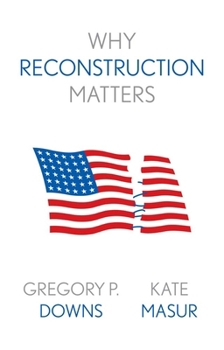
Why Reconstruction Matters
No Customer Reviews

A sweeping, ground-level reinterpretation arguing that Reconstruction both created the country we live in and sparked the battles that threaten to engulf it today
Far from a brief epilogue to slavery's end, Reconstruction was an era of epochal change. Emancipation transformed everyday life for nearly four million formerly enslaved Black southerners who became architects of freedom, creating independent institutions, organizing mass political movements, and, with white allies, driving the passage and implementation of the Thirteenth, Fourteenth, and Fifteenth Amendments. The amendments promised freedom, equality, birthright citizenship, and voting rights. This is the constitutional framework that structures American democracy today.Downs and Masur ground the narrative in nine distinct places that reveal Americans' struggles to deliver on the nation's most egalitarian promises, including
Green-Meldrim House in Savannah, where Major General William T. Sherman was headquartered and met with local Black leaders The streets of Natchez, Mississippi, where freedpeople celebrated emancipation, and Black communities developed significant political powerFirst African Church in Richmond, a center for Black spiritual life, politics, and community-buildingGrant Parish Courthouse in Colfax, Louisiana, site of the massacre of dozens of Black men
This accessible narrative shows how Reconstruction both created the country we live in today and sparked the battles that threaten to engulf it.
Format:Hardcover
Language:English
ISBN:0300276567
ISBN13:9780300276565
Release Date:March 2027
Publisher:Yale University Press
Length:320 Pages
Related Subjects
HistoryCustomer Reviews
0 rating
Copyright © 2026 Thriftbooks.com
Terms of Use | Privacy Policy | Do Not Sell/Share My Personal Information | Cookie Policy | Cookie Preferences | Accessibility Statement
ThriftBooks ® and the ThriftBooks ® logo are registered trademarks of Thrift Books Global, LLC
ThriftBooks ® and the ThriftBooks ® logo are registered trademarks of Thrift Books Global, LLC
