


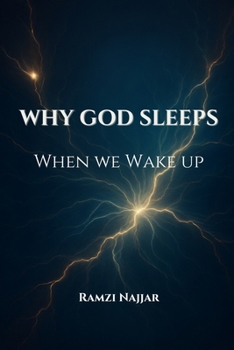
Why God Sleeps When We Wake Up

We were taught to fear God before we understood ourselves.
We learned to equate obedience with virtue, guilt with morality, self-denial with spirituality, and suffering with proof of faith. An unseen eye was always watching, judging, rewarding, and punishing-until that voice moved inside us.
We became our own judges.
But what happens when you stop looking upward for judgment and turn inward to examine the one doing the judging?
WHY GOD SLEEPS WHEN WE WAKE UP
A Philosophical Exploration of Spiritual Performance, Divine Expectation, and Existential Awakening
This book does not argue for atheism or attempt to disprove God. Instead, Ramzi Najjar examines something more intimate: the God human beings may construct within themselves.
How does fear become belief, belief become behavior, behavior become identity, and identity become an internal authority that monitors us even in solitude?
We may abandon religion yet still carry its courtroom inside our minds.
We may reject external judgment while continuing to punish ourselves. We may believe we are spiritually free while performing another version of goodness, purity, humility, or enlightenment.
This book explores fear-based spirituality, internal surveillance, self-judgment, spiritual performance, identity, ego, morality, and the need to be "good."
It also questions our habit of turning life into a scoreboard of reward and punishment. What if failure is movement? What if loss is transition? What if punishment is sometimes an interpretation rather than a verdict?
Nature does not ask permission to change.
Trees shed their leaves without calling themselves failures. Rivers flow without apologizing for their course. Life constantly changes form, yet we often interpret change as a judgment upon ourselves.
The journey moves from the God above us to the God inside us-from external authority to internal surveillance, from spiritual performance to authenticity, and from ego to presence.
The deepest transformation is not becoming a better version of yourself.
It is discovering what remains when the need to improve, defend, justify, purify, and perform that self begins to disappear.
When the throne is empty, there is nothing left to defend.
When the observer becomes silent, there is nothing left to impress.
And when the gods we created fall silent, perhaps awakening was never about becoming divine.
Perhaps it was about becoming present.
Inside this book, you will explore:
How fear becomes belief and later identity How playing "good" can conceal fear, self-protection, and the need for approval How ego can assume the authority once given to an external GodHow morality and spiritual identity can become constructions that protect the self-imageHow constant self-monitoring becomes psychological imprisonmentHow spiritual performance can replace genuine experienceHow to distinguish presence from another performance of enlightenmentHow to live without reward, punishment, certainty, or approvalHow to wake up without replacing one throne with anotherAnd so much more
It is time to examine the God behind your eyes, the identity you inherited, and the invisible rules you have spent your life obeying.
Question what you were taught. Confront what you internalized. Discover what remains when the performance ends.
Not obedience.
Not rebellion.
Not another identity.
Just presence.
Get your copy now and begin the journey beyond spiritual performance-toward presence, authenticity, and a deeper encounter with yourself.
Customer Reviews
ThriftBooks ® and the ThriftBooks ® logo are registered trademarks of Thrift Books Global, LLC
