


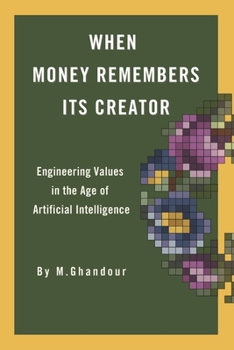
When Money Remembers...Its Creator: Engineering Values in the Age of Artificial Intelligence

Money has the power to build... just as it has the power to destroy. The question is not about money itself, but about the conscience that directs it.
FROM DANTE TO THE BLOCKCHAIN
Since the dawn of philosophy and faith, the real question has never been how much we own, but what we own, and why. Aristotle saw usury as a departure from nature. Aquinas called it injustice. Dante consigned usurers to the depths of Hell. The Old and New Testaments warned against it, and the Quran prohibited riba outright. Across centuries and traditions, human thought arrived at one truth: money that grows without work, production or risk does not accumulate wealth alone. It accumulates injustice.
Today, it faces its greatest test. The 2008 crisis showed where finance without conscience leads, and now artificial intelligence, blockchain and tokenization are rebuilding money from the ground up. Will these technologies protect human dignity, or quietly erase it?
THE QUESTIONS THIS BOOK CONFRONTS
Is money a medium of exchange or a commodity for sale? And why does the collapse of trust, from Weimar Germany to Venezuela, begin as a moral inflation before it becomes a financial one?Did complexity cause the catastrophe of 2008, and why did asset-backed Islamic structures take a different path?Has Islamic finance settled for formal compliance when its true calling is ethical mission?Can a smart contract be Shariah-compliant? The book shows how juristic texts become executable code, with digital ijarah, diminishing musharakah and istisna'a as working examples.Can tokenization democratize ownership through sukuk, real estate and commodities, and what Shariah and regulatory challenges must it overcome?Can artificial intelligence, from machine learning to agentic AI, become "a conscience that does not sleep" through Shariah RegTech, intelligent credit engines and preventive compliance?Who will govern the algorithm? The book answers with a nine-foundation roadmap toward a global framework for digital Shariah governance.THE ANSWER: ISLAMIC FINANCE 3.0
Dr. Mohamed Ghandour, a senior Islamic banking practitioner with more than twenty-five years of experience across the Gulf and beyond, proposes a new generation of financial thought: one that moves from formal compliance to ethical mission and engineers values into the very architecture of money.
Written with the depth of a practitioner and the reflection of a philosopher, this book argues that justice and efficiency are not enemies, that ethics is not the opposite of progress but its true essence, and that a new generation must emerge: scholars who code, and coders who understand jurisprudence.
Money is being rewritten in code. The only question left is whether justice will be written into it, or written out.
ABOUT THE AUTHOR
Dr. Mohamed Ghandour holds a PhD in Islamic Banking and Finance and AAOIFI's Certified Shariah Adviser and Auditor (CSAA) qualification. He has held senior leadership roles in Islamic banking product development, bank conversion and digital financial services across the GCC, MENA and Asia, and is the originator of the Islamic Finance 3.0 concept.
Customer Reviews
ThriftBooks ® and the ThriftBooks ® logo are registered trademarks of Thrift Books Global, LLC
