


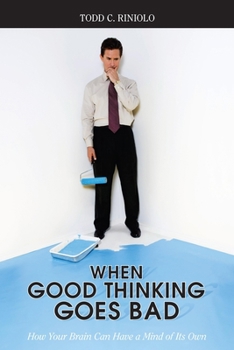
When Good Thinking Goes Bad: How Your Brain Can Have a Mind of Its Own

Select Format
Select Condition 
Book Overview
In this insightful analysis of the mental pitfalls that trip up even elite critical thinkers, psychologist Todd C. Riniolo makes a compelling case that under certain circumstances everyone is... This description may be from another edition of this product.
Format:Paperback
Language:English
ISBN:1591025869
ISBN13:9781591025863
Release Date:November 2007
Publisher:Prometheus Books
Length:236 Pages
Weight:0.71 lbs.
Dimensions:0.5" x 6.0" x 9.0"
Customer Reviews
5 ratings
A good, solid read
Published by Thriftbooks.com User , 16 years ago
The author makes a strong case, pointing out that even people who are proud of their critical thinking skills may, and often do, have some blind spots. Engagingly, he doesn't spare himself when he brings up examples of this. (Then again, I may just like this because it supported my own belief...) Beyond pointing this out, the first two sections examine *why* we're all prone to failure in critical thinking, with a very plausible explanation of why it's mandated by evolution, and how our emotional needs can get in the way of our willingness to examine, or even see, evidence that contradicts our convictions. He covers a broad range of topics in his examples: Global Warming, Politics, Economics, Psychic phenomenon (which he brings up a bit too often for my tastes), the Scopes Monkey Trial, and racial/multicultural issues - even Santa Claus, and the pros and cons of letting your young children believe in him. Part of my reaction to this is, quite likely, that he references other authors I'm fond of fairly frequently, such as Thomas Sowell, F. A. Hayek, and Milton Friedman - thus, as he points out, fitting into many of my preconceptions. The only reason I can't give this book 5 stars is relatively minor, but important to me - his voice. While considerably better for the general public than I'd expect from a scholarly work, his phrasing is too scholastic for the general audience he claims to be aiming for. I expect that his background in peer-reviewed articles is showing here. It's not bad, mind you - but he doesn't quite show a prose style that I could relax and let myself sink into, as opposed to, say Thomas Sowell, with his years of experience writing columns for the general public. In spite of this minor flaw, most readers won't be left in the dust, and I heartily recommend this book.
Well Done
Published by Thriftbooks.com User , 16 years ago
Riniolo demonstrates that even commonly accepted notions typically held by skeptics need to be challenged. As a result, he questions some of the assertions of skeptical giants such as Isaac Asimov. Riniolo even dared to mention that some of his own prior conclusions needed to be reevaluated. This is a primary strength of this book. In addition, readers will find enjoyable prose on several hot-button topics. A fun read.
This is a good low-density reference!
Published by Thriftbooks.com User , 17 years ago
Now what does that mean? Simply that you will find yourself coming back to this book to look up certain examples, argument points, and general "rules" of good thinking from time to time, and it does not read "thick" - dense - like a dictionary, say. This makes it fun and easy to thumb through for later look-ups, after having been fun to read through the first time. A book with this rather forbidding title actually becomes less intimidating when picked up, because it consists of only 215 paperback pages. The three parts of this work are: the characteristics of good thinking ("rules," loosely, although not called this by the author), how good thinking evolved, and examples of good & faulty thinking. Those examples will likely hold some surprise for most readers. Also, there is an early short example of how Isaac Asimov, a brilliant and incisive thinker, ended up making a terrible boo-boo of a prediction at mid-20th century. As with most boo-boos, this was a result of a hard-to-let-go prejudice on Dr. Asimov's part. The author uses himself as a bad example in telling of his own preconceptions about the Spencer Tracy movie, "Inherit the Wind" (fictional tale paralleling the Scopes trial), and how the facts turned out to be quite different that what he had always assumed. This may be the most interesting example in the book. A minor criticism: the author uses many clichéd phrases. "To make a long story short..." was a personal ear-grater, and showed up too many times in the text. Some would argue that ONE time is too many. Anyway, just get past those, and chalk it up to a dearth of good English teachers in his youth! Buy this one, rather than checking from the library, to be able to thumb through it many times.
A Fun & Interesting Read
Published by Thriftbooks.com User , 17 years ago
This is a very interesting book written in a style that is very readable. The author's major thesis is that everyone, even elite critical thinkers, will because of the biases that are part of humans evolutionary heritage, be prone to believe in nonsense. With that in mind, the book is separated into three parts. Part one is really advocating critical thinking as the best method to evaluate claims, and the author reviews some of the basics. Part two provides an evolutionary explanation why everyone is prone to "bad thinking" sometimes. The author speculates that certain biases helped to maximize humans' pattern-seeking abilities. Finally, part three is the most controversial portion of the book. The author uses a wide range of examples (global warming, political claims, multicultural claims, economic claims, even Santa Claus) to show how even "good thinkers" can abandon their skepticism under certain conditions. While I did not agree with all of the authors conclusions (he often takes a position that is the opposite of many critical thinkers), the book will make you think about how much evidence you have to support certain beliefs, which I guess was the point of the book in the first place.
It makes you think!!!!
Published by Thriftbooks.com User , 18 years ago
This was a very interesting read. People who read John Stossel would love the thought provoking subject matter of this book.
Copyright © 2025 Thriftbooks.com
Terms of Use | Privacy Policy | Do Not Sell/Share My Personal Information | Cookie Policy | Cookie Preferences | Accessibility Statement
ThriftBooks ® and the ThriftBooks ® logo are registered trademarks of Thrift Books Global, LLC
ThriftBooks ® and the ThriftBooks ® logo are registered trademarks of Thrift Books Global, LLC
